
Auriga Space is developing the electromagnetic launch capabilities to send more mass to space
If you want to move around Earth you can choose between planes, trains, and automobiles. If you want to move off Earth, the answer is always rockets. That lack of options is causing congestion in the launch market that’s leading to some radical approaches for easing access to space. Ideas that have been confined to the texts of Jules Verne and advanced research projects, are starting to gain appeal. Auriga Space is leading the charge on developing an electromagnetic launcher that can address the rapidly increasing amount of mass being lofted to orbit in a way that is more environmentally friendly, and can launch at the higher cadences that are increasingly important for satellite programs.
Though the idea has been around since 1865, 100 years before the start of the space industry, the technology and market environments are only recently ready to make the concept a reality. Falcon-9 retiring has spurned a mad rush for alternatives that’s affecting everybody. Europe is ramping up Vega launches, rushing ISAR to orbit, and even funding The Exploration Company to the tune of $450M for a reusable rocket. Japan’s H3 got a contract from Exolaunch, India’s LVM3 got more launches including for AST Spacemobile after they had to pivot away from New Glenn, and Australia spent $145M to fund Gilmour’s development. Even the US government is scrambling with a $150M loan to Stoke Space on top of the $1B they raised just a month ago. All this effort though, and it doesn’t fix the problem. Even at scale rockets are expensive pieces of equipment, they often get compared to airplanes as if that’s the ideal of a commoditized system that’s cheap and reliable. If you’ve ever flown, you know that’s an outlandish claim. The reality is these will remain expensive, as indicated by SpaceX’s success. While Falcon brought the cost of launch down precipitously, the juice, apparently, wasn’t worth the squeeze. As shown in their S3 when they went public this year, launch is the least profitable part of their launch company. Instead it highlighted the vast and growing value of satellites, specifically their own. The learning from this is that many satellite companies are now pursuing their own launch vehicles. Cowboy Space is building a rocket for their orbital data centers, AST Spacemobile is partnering with Firefly to build one for their Bluebirds, and it’s looking like CesiumAstro may be following suit. This outcome doesn’t solve launch though, if anything it’s likely to lead to a different form of congestion at limited spaceports, and in FAA regulations. What would be really valuable is a relief valve, a system with faster turnaround that can lift the bulk of mass to space and allow the rockets to focus on the more fragile and bespoke payloads (like humans). Auriga Space is developing just that, a launch system that can fire as fast as needed, and at lower costs since it doesn’t rely on consumables to operate.
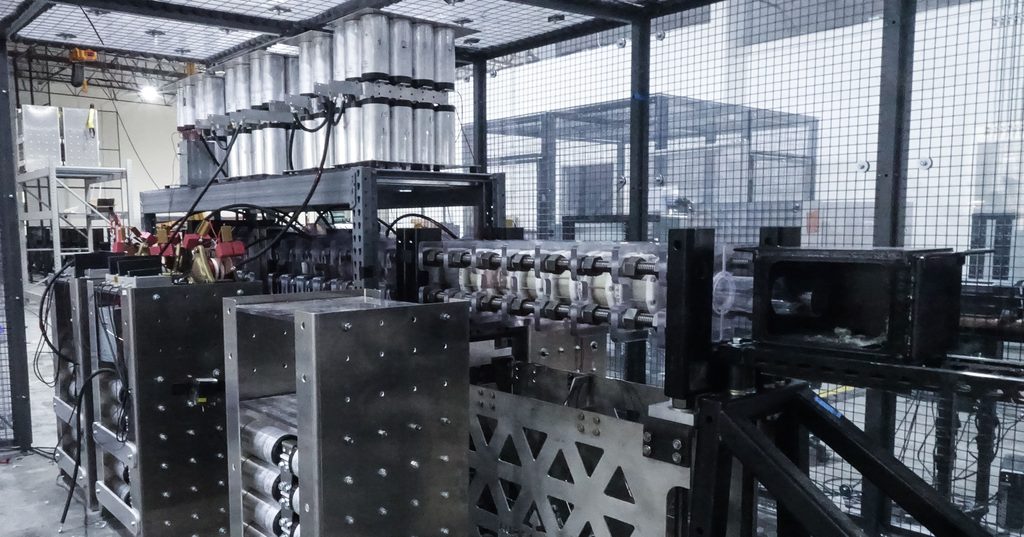
The knee jerk reaction to kinetic launch systems has always been doubt, but that was the same response SpaceX got when they pursued reusable rockets. The physics are tricky from a technical perspective, but is compounded upon by the lack of funding. The closest we’ve gotten was with Gerald Bull and the SHARP program, but once rockets took off, the focus narrowed to that solution. Now a confluence of events is justifying revisiting kinetic launch, not only the economics of the crunch on access to rockets, but also the progression of key technologies. Winnie Lai, CEO of Auriga Space, highlights a key factor “a big part of this is the way we believe that electricity can scale, right? If you look at an adjacent industry, like fusion, nuclear fusion, again, like the concept of fusion has been around for decades. But why is it that in the last like 10 years, companies are raising again like tens of billions of dollars? It’s because of the advancements in power electronics, and also the availability of electrical components like off the shelf that can handle higher voltages, higher current, higher power. That’s why I believe that electromagnetic launch is the way to go. There’s possibilities to scale this by riding this wave of new technology advancements.” That scale is a critical factor for electromagnetic launch to capitalize on the immense growth in the space industry. Being electric also allows it to leverage the unavoidable shift towards environmentally friendly energy sources, while rockets don’t launch enough now to be a significant problem, they will become one if the industry has its way of launching dozens of new rockets thousands of times per year. If the rocketeers are to be believed though, that day is soon approaching, so preparing for it now is valuable, which is why Auriga has started building the necessary components.
They’ve done this by capitalizing on adjacent markets that could also use electromagnetic acceleration, most notably hypersonics testing which has seen growth through programs like MACH-TB 2.0 which has awarded $1.45B to Kratos and $190M to Rocket Lab, as well as counter-UAS which has seen increased demand from conflict regions like Ukraine and Iran. Winnie explains how they’ve developed products to address both applications, “we can take the technology that we’ve developed for Prometheus, which is our hypersonic test bed, and then convert that into a deployable platform for counter drone capabilities. So that’s actually how the concept of Hermes came about. and Hermes is right now a 10-foot shipping container with an electromagnetic launcher housed inside it, which is a quarter of your standard forty-foot shipping container that goes on the ocean carriers.” That shipping container is a scaled down version of the electromagnetic launch system that they’re developing in parallel, and it enables a couple things. One is it generates revenue from a customer that they can serve right now, and the other is that it enables them to use that money to develop in-house all the parts needed for the eventual system. Instead of scaling Prometheus down, this combo will enable them to scale up.
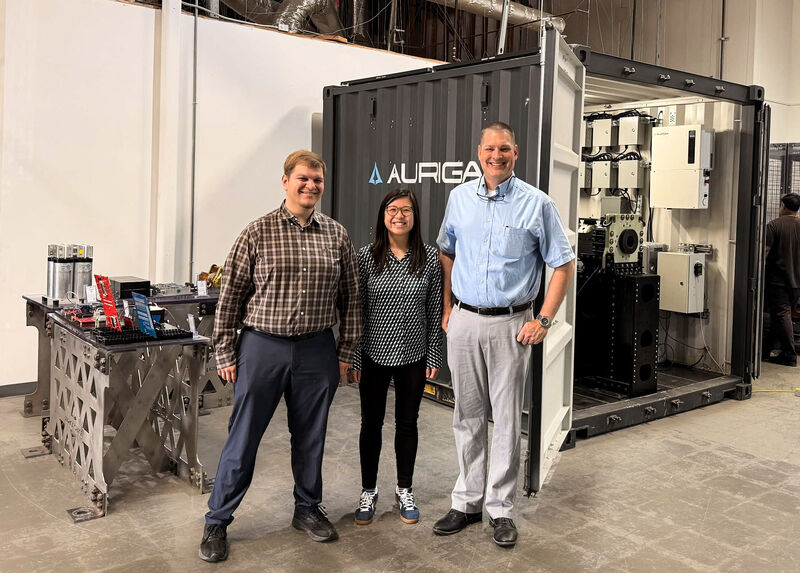
There’s also an increasing possibility to use the accelerator for more nascent mission types like space mobility and orbital interceptors. Winnie proposes that “the technology that we’ve developed for Hermes, instead of putting it in a shipping container, what if you swap out the shipping container for a satellite bus? Depending on which direction you point in you can either have a missile defense platform from space or you can also have an orbital transfer vehicle platform, so to speak, that does not rely on chemical propellants because we know getting chemical propellants up in space is also not gonna be cheap, right?” Both are rapidly emerging sectors in the space industry as Golden Dome has made it a priority in their $185B program, and more rapid space movement has been a topic of focus with the increase in adversarial activities in space. The Victus missions have been pushing the boundaries of space responsivity, bringing time to launch to under 17 hours, Auriga could have a turnaround even faster. And with adversarial maneuvers increasing like with Russia’s close approach to a US owned SAR satellite last month, the pressure to increase the speed at which satellites can move to evade and intercept makes a compelling argument for EM launch platforms on orbit.
Longer term there’s also the possibility of electromagnetic launch on other planetoids to establish a railway of sorts for interplanetary resource transportation. It’s a concept that’s recently been proposed by SpaceX to launch orbital data centers from the Moon to avoid Earth’s expensive gravity well, and is a concept that excites Winnie. But she is very pragmatic in her response to the future Auriga can unlock by “making the hypersonic test business work. Let’s also make the counter drone and missile defense business work. And at the same time we are continuing to develop the technology for space launch, but recognizing that’s going to be a bit further down the line.” For an industry panicking over the loss of their workhorse rocket, that time can’t come soon enough. So if you’re interested in helping enable electromagnetic launch through work, investment, or partnerships, then be sure to contact Auriga Space!
Watch the full interview on YouTube!




Leave a Reply