
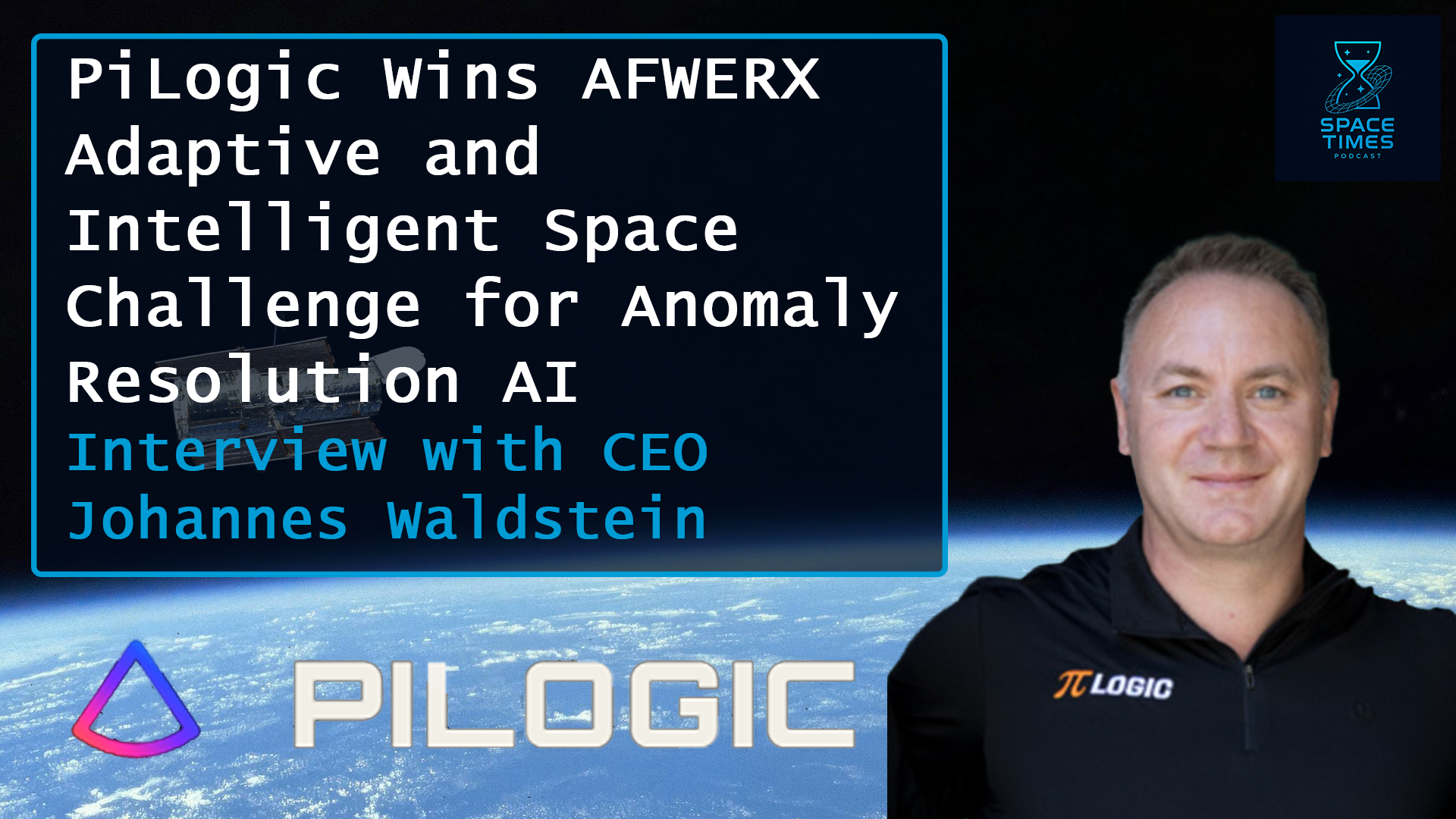
PiLogic provides transparent AI to prevent anomalies for more adaptive and intelligent spacecraft
“Space is hard” is the axiom that runs through the space industry. “Seraphim Space has 140 portfolio companies. Almost every portfolio company that has satellites in space has either lost satellites or had anomalies that degrade the satellite” explains PiLogic CEO Johannes Waldstein. The universality of the problem is what makes it so pressing, and as the number of satellites in space increases, the problem is magnified to the point that radical new solutions are necessary. Traditionally anomalies are resolved by engineers on Earth, but not having direct access to the spacecraft makes troubleshooting a time-consuming activity, and every hour spent fixing a spacecraft is an hour that it’s not generating revenue. While a human can’t sit on the spacecraft endlessly probing for the source of an issue, an AI can. That’s what PiLogic has developed, an AI that can constantly monitor the satellite to not only diagnose problems quicker, but also predict and prevent them from ever happening; all this with algorithms that are able to explain the reasoning and physics that drives its decisions so engineers can audit their actions, and eventually trust their control.
Spacecraft are complex systems of systems that control everything from power to thermal to flight. Any one of those falling outside nominal operations can disrupt service for communications or imaging or any other activity that’s generating money for the owner. A power system can trip like on Katalyst’s recent Link mission that ended its mission before it could complete the objective. High temperatures can degrade control systems like on Albedo’s Clarity-1 mission that lost the ability to point their camera accurately. And communications can lock you out entirely like in the case of Starfish Space’s Otter spacecraft just this week having a fault system turn off the radio used to communicate with the satellite. Starfish’s case most acutely highlights the value of PiLogic, as Johannes explains “the problem with rules is that you have to come up with the if-then ahead of time. So you, as the electrical engineer, as the flight software engineer, you have to say, in this scenario, do this, but not that. The challenge is that there are hundreds of millions of edge cases, and those are not well covered by rules. And so you get into a situation where you catch about 40 to 50% of faults in tests.” In the case of Starfish, the fault detection didn’t just miss an edge case, it created a fault response that cut off the ground team from being able to recover. If PiLogic’s software were loaded onboard, then the satellite could recover on its own, re-establishing contact with Earth for the team to recover their spacecraft and continue the mission. Instead a set of engineer-designed rules ended the mission before it could start.
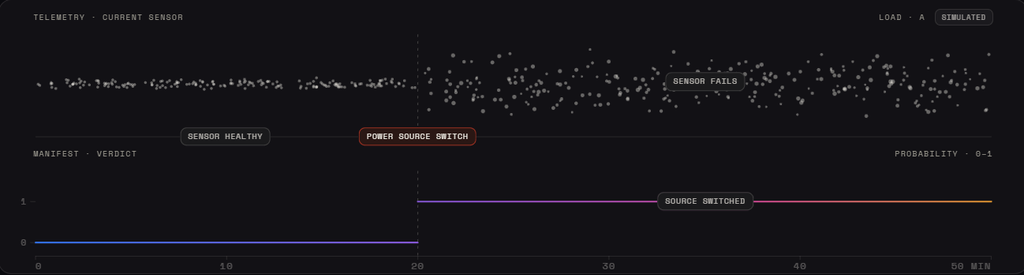
Even in the scenarios where a mission is not ended by an anomaly, the impact is still significant. A majority of satellites are deployed to LEO orbit, where they fly overhead at 7km/s. That means an operator on the ground only gets about 10 minutes of time to communicate with the spacecraft about every hour. That means when a satellite encounters an anomaly it could take an hour before the operator is aware. The data then has to be transmitted to Earth before the operator can analyze the situation; then another hour passes. A solution is formulated in that time, best case it’s uploaded in the next contact and the satellite recovers in an hour. Worst case, the solution doesn’t work, and the cycle of troubleshooting compounds hour over hour. Each hour eats into time that the satellite could be taking pictures or providing communication and generating money. This also requires paying an engineer to focus on solving this problem. Not only does that cost money, but it doesn’t scale when you need to manage hundreds or thousands of satellites.
This situation is quickly becoming untenable as megaconstellations increase in number. Satellite operators are eager for a better solution, but are still reluctant to allow AI to control their multi-million dollar assets. That’s where PiLogic has built a solution that addresses those concerns, while providing a solution to the underlying problem. Most AI solutions leverage large language models that are cutting edge but are not deterministic enough to establish confidence in their actions. Johannes explains that their approach avoids that uncertainty with a different approach: “what’s interesting about our models is they’re both probabilistic in that they are predicting the probability of a certain thing, but they’re deterministic in that with the same inputs you get the same outputs. So the problem with a generative model is that you can give it the same data and it will have different answers, ours always has the same answers. It will tell you with probability 99% it’s the sensor, or with probability 50% it’s the sensor, but run these tests to try to validate it. So it’s really good for the operator because you can track the causal chain back and see that determinism.” This is optimal because it allows the operator to run it as a diagnostic tool while still allowing a human-in-the-loop to make the ultimate decision, or allow it to run autonomously with a level of traceability that enables the engineer to audit its decision chain to both validate its reliability, and potentially learn new methods of diagnosing issues.
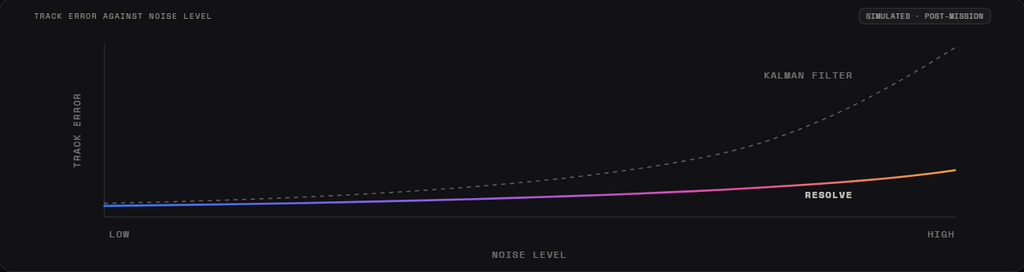
The approach they’re taking extends beyond satellite operations to the payloads, meaning they can not only ensure revenue generating activities stay online, but also augment their value. PiLogic already offers Resolve, a product that improves radar’s ability to locate targets. Johannes explains that “in radar, we know about the physics of flight, we know about what happens above the atmosphere when you come into the atmosphere, and the laws of physics within the atmosphere. So we know a lot of math about what the environment is. But what you don’t have is its exact position and velocity. And especially if data is being hidden from your sensor, you only have intermittent and spotty data. And so what our model is able to do is use exact search and dynamic base nets to reason about what is the realm of the possible, and then where it most likely is within the realm of the possible.” Due to PiLogic’s AI being Bayesian, it is rooted in math and logic rather than pattern recognition like the more common LLM forms. This is the factor that makes it deterministic, and traceable to the first principles that it’s operating on. It also means it’s well suited to solve many problems encountered in space, so not only monitoring that a spacecraft’s systems are operating nominally, but also inferring the behavior of the environment it operates in and observes. While the current value of their product is focused on satellite operations and radar payloads, the underlying technology can be applied to a breadth of other applications. It could be extended to helping the engineering that goes into development, or imaging for space domain awareness. Currently PiLogic is building up from the most in-demand applications though, as radar is also seeing immense growth from the defense sector due to increased deployment of jamming technology and the popularity of synthetic aperture radar and space-based airborne moving target indicators.
Whether you use radar or not, PiLogic can improve your satellite’s operations. They provide the controls to deploy their AI to your level of comfort, and expand as your trust in the system does. Implementing their tools early can help avoid the headaches of unforeseen anomalies derailing your mission, and prepare your spacecraft for more features as PiLogic develops them. Johannes emphasizes that “We want math, we want physics, we want explainable, we want something knowable.” And knowing that your spacecraft is safe and can operate to its fullest capabilities is something everyone wants; now you can have it with PiLogic!
Watch the full interview on YouTube



Leave a Reply