
Sophia’s Edge Compute Technology Stack Builds an Agnostic, Infinitely Scalable Server for Whatever Processing and Compute Needs Clients Have.
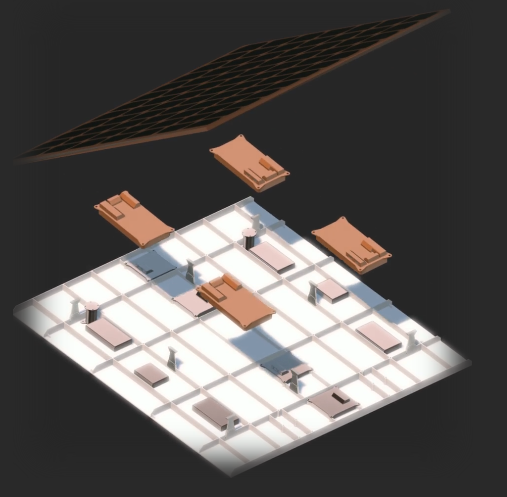
Sophia Space has built the fundamental technology necessary to win their beachhead market of Edge Compute – the first step in terms of compute size towards the magnitude of Orbital Data Center projects that we anticipate towards the decade’s horizon. Edge Compute is a rapidly growing and adapting marketplace that is largely still highly competitive and fragmented. Sophia’s flexible and agnostic solution to the edge-compute market’s needs involve their BLADE, TILE, and Satellite product offerings, and the Sophia Orbital Operating System (SOOS) offering that ties everything together. BLADE represents Sophia Space’s compute module. It is currently designed to support and fly with the NVIDIA Jetson GPU architecture, however is flexible enough to support a wide variety of different GPU architectures as well, as Sophia Space is currently designing to scale for the power and thermal needs of the Vera Rubin for their longer term data center product offerings. These BLADE modules are paired up and launched as a group of four in a single Sophia TILE. The TILE represents a layered-satellite approach to the payload in question: solar cells on one side followed by an insulation layer; inside the insulation layer are the Jetson GPUs and the compute layer as a whole; that compute layer is stacked on top of the Thermal Control layer which distributes and evens the heat dissipation and rejection across the whole surface area of the 1m x 1m TILE structure; the final layer represents the radiator layer, as that uniform thermal load is then cooled via radiation out to the space environment. The BLADE GPU modules are connected to an internal network within each TILE, and each TILE connected with each other, via an internal optical connection as part of the compute layer. This internal network allows for the SOOS to manage the entire network’s array of TILEs and coordinate processing needs to manage the entire job and hardware suite as needed. “SOOS interacts with other SOOS instances that are running across all those TILES and it takes an active part in the heat management… It will do firmware upgrades, security patches, operating system upgrades… and also take care of process and heat management.” – Rob DeMillo, CEO and Co-Founder of Sophia Space.

The Edge Compute market represents a customer whose primary value add is the timeliness of the data and derived insights being provided. In so many words, the promise of Edge Compute has always been ‘real time’ data: the ability to run models on orbit, process through gigabytes of data before transmitting down the final insight or answer within moments that only constitutes a few megabytes of information. The nature of time-sensitive intelligence and earth observation data has some very clear implications as to who the primary customers and stakeholders are likely to be. Most commercial insights and earth observation data are not particularly time sensitive; yesterday’s data is for all sakes and purposes just about as valuable as today’s data, at least, for commercial use cases. As such, the willingness to pay for timely data isn’t really driven by the commercial sector. However, for defense, security, and customers who need to have actionable insights and intelligence as fast as possible, the cost sensitivity found on the commercial side is simply not present. Defense and security related customers and stakeholders are willing to pay a significant premium in order to solve the capabilities gap and get real-time information into the field ASAP. The obvious implications and use cases for this involve early missile detection and tracking, asset monitoring and tracking, and similar use cases.

This means that Sophia is able to help underpin and enable edge-compute for missions that have already launched their space based assets. For example: a hypothetical Earth observation constellation of 6 SAR satellites is tasked with observing and providing insights on potential military asset deployments and movements in a geographic region of interest. These SAR satellites would currently image Earth in said region. Those images would then be routed through a ground station depending on the asset’s orbital trajectory, the ground station’s demand, and the ultimate size of the image that needs to be transmitted. That process itself can take anywhere from hours to days to handle, meaning that an image taken Sunday morning may not even begin to process under this traditional workflow until Wednesday. That image then needs to be analyzed, processed, and then the ultimate insight or actionable intelligence can be routed or communicated with the relevant parties. There are some players in the Edge Compute space who are designed to fly bespoke solutions for individual customers and clients. In this example, they would build and fly a new SAR satellite to replace or supplement the existing constellation. This satellite would then bear both the SAR and the edge compute payloads, capture the image, process the image, and transmit the data all as necessary. However, Sophia’s technology stack enables them to launch an asset with only the edge compute payload to supplement an existing constellation’s capabilities on orbit. By flying one of Sophia Space’s satellites in close proximity to the imaging asset, Sophia is able to effectively append their edge compute capabilities to existing earth-observation assets as needed. Their assets are wholly agnostic as to the type of payload that they’re ultimately supporting, as they’re effectively flying a server for whatever unique mission the customer requires. These servers are mass produced, standardized, and don’t see any meaningful NRE between missions to customize for the task at hand. “We’re largely following the same playbook that Dell did terrestrially. We’re building servers for orbital needs and eventually we’ll build out and include the computers themselves as well.” – Rob DeMillo.
Orbital Data Centers are a massive investment in orbital infrastructure that represents a widespread belief in the end user and customer’s overall ambivalence towards the source of the data center that underpins the products and services they consume. That belief has largely been proven out over the past decades of Data Centers construction and operation for traditional compute needs that we’ve seen. There’s been a significant increase in awareness of and aversion to data centers as the rise of AI compute needs and hyperscalers growth plans have seen data centers footprints grow exponentially. Taking aside the opposition to data centers being constructed in communities for the second-order effects that adversely impact those host communities, the historical trend is that customers largely don’t care where the data center that underpins their consumed products or services is housed. Arizona, Wisconsin, Nevada, Internationally, customers and users haven’t largely cared. They’ve been much more concerned with the products and services themselves functioning reliably and without interruption. Speaking more to terrestrial data centers’ stiff opposition, there’s a lot of reason to believe that the Orbital Data Center solution would assuage the majority of the concerns voiced by terrestrial data centers. No impact on utility prices such as water or electricity, substantially improved environmental impacts and performance, and no adverse health or environmental impacts on host communities from the power generation needs of these orbital data centers paint a very favorable regulatory picture as to why ODCs may prove to be the viable answer. Sophia’s perspective on the ODC market is that it’s the inevitable direction the industry is headed. The compute needs are here to stay, the pushback against terrestrial data center solutions, and the sheer abundance of energy and cooling solutions on orbit make for a certainty that the ODC infrastructure necessary to service that compute need will materialize over the coming years.
Anybody interested in joining Sophia Space’s projects and vision should reach out to the team here, as they’re currently growing and executing towards their demo missions scheduled for later this and next year! If you’re interested in learning more about Sophia’s product offerings or a potential partnership, they’d love to hear from you on their contact page!



Leave a Reply