
Diffraqtion can use their quantum cameras to see better than classical optics and faster than traditional computers can keep up with
Kodak dominated the camera industry for decades with film photography, a slow and intensive technology that seems antiquated compared to the digital photography that replaced it. We even had the Corona spacecrafts back in the day that would take pictures from space then drop the film canisters to Earth for development. Now cameras numbering in the thousands orbit Earth snapping pictures and sending them down as digital bytes. But that’s about to change as well. Quantum cameras are poised to disrupt digital even more dramatically than digital supplanted film. Quantum cameras can see 10x further, process data 10x faster, and use 10x less power; and Diffraqtion is at the forefront of commercializing the technology.
Their namesake comes from the core challenge they’re tackling, the diffraction limit. This physical constraint limits the resolution that a traditional camera can achieve. CEO Johannes Galatsanos explains it as “…basically the last letter you can read when you go to the optometrist where it gets blurry. That’s your eye’s diffraction limit. So, if you take a picture of that, you see a blur in a camera. If you get a better camera, then you just see a more high resolution blur.” Their quantum camera gets around this by capturing light as photons rather than waves, being able to pick out each individual quanta of detail. This method provides the additional benefit of being able to capture more detail from the light. Traditional camera sensors use pixels to simply count the number of photons to measure intensity, creating an image that only represents the relative brightness of a scene. But photons contain thousands of other modes that describe other properties of their sources like material, orientation, and movement. With current capabilities, extracting these details requires capturing a picture (in some case multiple) to then pull detail out of whatever was captured, but even with AI advancements this process is limited by the speed of electricity passing through a computer, and still is missing all the details that were lost by the form of capture. By contrast Diffraqtion’s camera captures all of these properties directly by manipulating the light, which is why they can “see faster” because the details are being captured before they ever reach an electronic device. Their technology manipulates the wavefront of light entering the camera to divert specified details to their detectors, much like you can extract a bass line from a musical waveform to isolate a certain property of a song, they are able to do that with visual signals. These isolated properties are captured in a sort of data structure that describes the target object, which they then train their system to identify by the unique combination of characteristics. Their methodology allows them to rapidly capture more detail, enabling a (pardon the pun) quantum leap in imaging technologies.
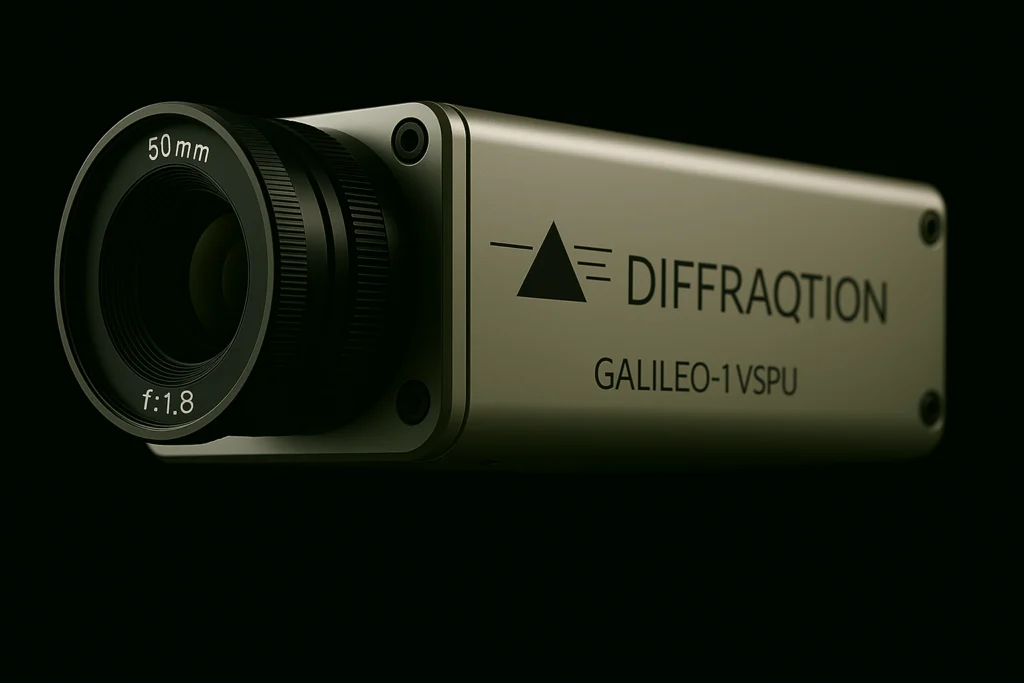
While their technology can be used in any kind of imager whether microscopy or space telescopes, they’re starting with space domain awareness because the targets have plain black backgrounds making it easier to isolate the subject, and thus more easily train their system. While their system is being improved, they are able to still deliver value as the initial targets can be space objects of high value for monitoring like adversarial satellites or missile threats. Both applications are of immense importance recently with billions of dollars being spent on space domain awareness, and hundreds of satellites being deployed for missile detection and defense. Johannes describes their product as “…a little cubesat that has the same resolution as the big…Vantor birds, right if you think about the 1.5 meter or so lenses which cost you 100 million upwards, this one [Diffraqtion’s] costs you two or three orders of magnitude less than such big satellite systems. So in space the whole unit economics go wild, right, even on Earth they go wild because you can make a tiny telescope into the world’s most powerful telescope. But you can make a tiny satellite, the world’s most powerful space domain awareness satellite, or turning it down as an Earth observation satellite.” The size, cost, and speed indeed have immense implications for SDA constellations, reducing the cost to deploy constellations and thus the resiliency to replace should something go wrong. And the speed of reaction is critical, the faster an imager can identify a threat and communicate a response, the better the response of the whole system. The higher levels of detail also mean that not as much data needs to be sent from the satellite because the data structures that it generates are smaller than a high resolution image, further reducing the latency of response, and the overhead cost of communication systems. Looking at all of this it’s obvious that there’s other sectors of the space industry that can benefit from this technology such as rendezvous proximity operations where rapid autonomous operations are critical to mature the capability. Ultimately every aspect of space that requires an imager can benefit from adopting Diffraqtion’s solution.
Earth observation is a major sector that could also benefit, and a larger application of imagery in the space industry, but has been going through a shift recently. Earth intelligence is the higher value product that can be produced by satellites, where AI extracts information relevant to the end user and delivers it in a timely manner rather than full images. Diffraqtion’s advantages position them to deliver on the value of this shift with potential to be the ultimate solution. Johannes highlights that “…the entire inference is done photonically and that means that let’s say that that happened at speed of light right because it just needed the light to travel through it. and that is kind of billions of times faster than a GPU multiple orders of magnitude. It’s just that at some point you have to read out the information, And when you read out that inference, there’s no point sending something at, picoseconds speed to a processor because no processor is that fast to even process this information, So we already exceeded the limits of what the downstream technology can do, so at some point maybe the downstream compute catches up with us and then it can also process quickly, but we’re just limited to the downstream computers.” That distinction means they’re also faster than the radio can transmit, but both technologies are also in the process of being disrupted by quantum in the form of quantum computers and quantum communications. Diffraqtion’s technology could one day integrate with these systems to provide delivery of insights at the speed of light, they would enable Earth to finally have real-time knowledge of everything. That everything could include places other than the Earth, as space domain awareness for the Moon has become an emerging need with the announcement of Oracle Prime by the USSF. Simply adding Diffraqtion’s cameras to these satellites unlocks the next layer of capability for any imaging application. Whether it’s a telescope, a microscope, or your phone’s camera; Diffraqtion has the potential to advance any technology that captures a record of reality.
That future could be closer than we think as they’ve raised an oversubscribed pre-seed round this year, deployed two cameras to observatories for Earth-based SDA, and their first satellite is being readied to deploy in 2028. Even before then, any satellite that wants to advance their capability can get a camera from Diffraqtion to integrate into their system. Every camera they launch will accelerate their efforts to mature their technology to the ultimate goal of being able to classify everything in our universe at the speed of light. Soon enough, when we think of a “traditional” camera, we will be thinking of Diffraqtion’s quantum camera. If you’d like to level up your satellite’s capability, or help accelerate Diffraqtion’s proliferation by working on their team, then be sure to reach out to them at contact@diffraqtion.com!
Watch the full interview with Diffraqtion CEO Johannes Galatsanos on our YouTube!




Leave a Reply