

Juno Propulsion provides a plug-and-play rotating detonation combustion thruster for higher speeds and fuel efficiency in space
Rockets are easy, burn fuel, go up. But anyone that works on them knows that reality is much harder: high pressure systems, high speed turbomachinery, high temperatures, and highly violent vibrations. Deal with all of that and you’re still left with an intrinsically inefficient system since fuel doesn’t burn completely before it’s ejected. What rotating detonation rocket engines do is rethink the first principles by instead exploding fuel in controlled bursts, burning only what is necessary for each impulse, resulting in 10-15% increased efficiency in thrust to fuel ratio. It’s an enticing idea that’s been perpetually in development since the 50’s; although there are no moving parts, the shock wave becomes the moving part, and that has been hard to scale without exploding the whole engine instead of just the fuel. Juno Propulsion looked at this problem though, and decided it was a solution, because even at small scales their technology is a perfect fit for spacecraft.
Since Juno doesn’t currently use their engine for rocket engines, they’ve dubbed their technology as Rotating Detonation Combustion (RDC), and tout a 5-10% increase in efficiency over existing chemical thrusters. Impressively that’s all gained through the mechanism they’ve built, and not a quirk in the fuel or mixing ratios because as CEO Dr. Alexis Harroun highlights they’re “a fuel agnostic and size agnostic technology, we can detonate anything!” though they are starting with “a storable propulsion system, powered by nitrous oxide and ethane which are basically infinitely storable on orbit.” This offers a significant flexibility to their thruster that’s not common amongst alternatives, most thrusters are designed around a specific fuel and ties the spacecraft design to its configuration, storage, and handling constraints. It means that their thruster can be easily integrated into existing designs to add an extra oomph. Also of note in Dr. Harroun’s comment is the focus on nitrous oxide and ethane, it’s a very prescient decision as early movers in the on-orbit refueling sector have also focused on this fuel as it’s easier to store and transfer while remaining highly efficient at storing energy. This means Juno is positioned well to serve as a critical component in the emerging infrastructure that’s building around providing multi-mission, high mobility infrastructure to deploy and maintain a more persistent presence on-orbit. Their small form factor and fuel flexibility enables them to extend the reach and speed of delivery for on-orbit refueling depots for architectures like those being pursued by SpaceWERX In-Domain Orbital Logistics Challenge.
The US Space Force is expanding space mobility capabilities rapidly due to defense needs. Russian and Chinese demonstrations in the past years have prompted a response in the form of more agile spacecraft that can move to intercept adversarial interaction with on-orbit assets, and Golden Dome has allocated over $1T to space defense including space-based interceptors that need to move quickly from spacecraft to interdict missiles. These demand signals have led to new classes of highly mobile satellites like True Anomaly’s Jackal that received $650M in funding after winning a contract under USSF’s $3.2B SBI program, Portal’s Starburst highly maneuverable spacecraft, and Impulse Mira’s orbital tug. Momentus is an orbital tug company that may also be joining that class of satellite given that it will be flying Juno’s project Iris onboard their Vigoride 8 spacecraft next year. This mission will demonstrate Juno’s RDC on-orbit under NASA’s Techleap program, proving their thrust levels as well as minimum impulse bit which is a key metric for the controllability of their engine. Even though JAXA has tested RDREs in space, Juno will be the first commercial company to demonstrate its capability for on-orbit maneuvers. Such a big leap is likely only the first step for their technology as space mobility is expanding beyond the Earth with the Moon becoming an increasing priority for the US government. Just this month DARPA awarded three contracts for low lunar orbit propulsion, notably all winners utilize chemical propulsion as well as electric propulsion. Juno’s flexibility enables them to easily expand into new opportunities as Dr. Harroun explains their technology is plug-and-play, “you bolt on our system, you plug in electrical umbilicals, telemetry umbilicals, [and] you’re off to the races” meaning their RDC could be a key solution for the challenges of moving around more than just the Earth.
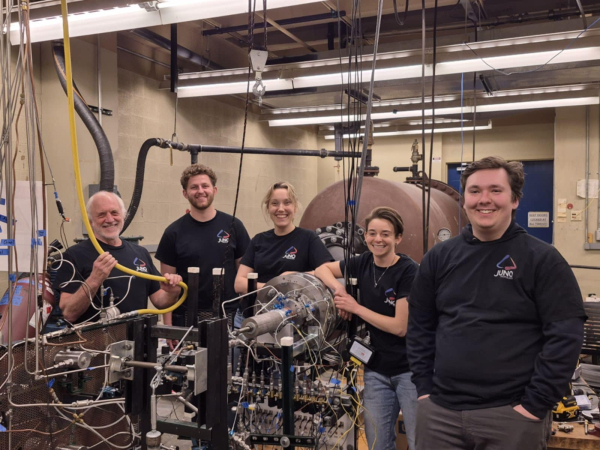
There’s opportunity in the other direction as well, as most RDRE’s have been focused on terrestrial applications. DARPA has also been working on rocket engines with RTX and Pratt & Whitney, while Venus Aerospace and General Electric have been developing their own capabilities. Their technologies are primarily benefitting markets adjacent to space, with none explicitly focused on launch vehicles, but rather missiles and hypersonic testing. It is another domain that Juno is planning to operate in as Dr. Harroun explained “we are doing RDC technology propulsion systems for everything from in-space, we’d also like to do upper stage engines, there’s a lot of buzz around space based interceptors, [and] eventually we would like to go do launch vehicle engines.” This strategy allows them to address the much larger space market while developing their technology further to potentially scale it up to the sizes needed for rockets. They’ll be able to operate in an arena with only one foreign state “competitor” while they develop their product, then scale into markets with more competitors with their experience guiding them to a more mature solution. Should they grow to include the launch market, then their propulsion efficiencies could expand up and down the entire chain providing a better solution to get to orbit, operate in orbit, and even in other orbits; all while having flexible on-orbit refueling solutions expanding their ecosystem. It’s not often that a technology comes along that can provide benefit to every aspect of a market, but Juno has the potential to provide a product that could expand our reach in space at every level.
Juno Propulsion has developed a product that encapsulates a complex engineering challenge in a flexible form factor that can plug into any platform and leverage their architecture to provide a boost to efficiency and mobility. Being the only RDC to fly in space will give them a unique offering to the US government and its partners in its race to provide increased space mobility, enhancing their reach and ability to respond to the increasing threats in space. Nuclear may be the only other form of propulsion that can promise a radical improvement in thrust capability, but compared to that, RDC is a much more feasible solution to improving mobility. If your spacecraft could use an extra boost, or you are interested in how Juno’s RDC can upgrade your spacecraft’s capability around Earth and beyond, then be sure to reach out to Juno Propulsion!
Watch the full interview on Space Times’ YouTube




Leave a Reply