
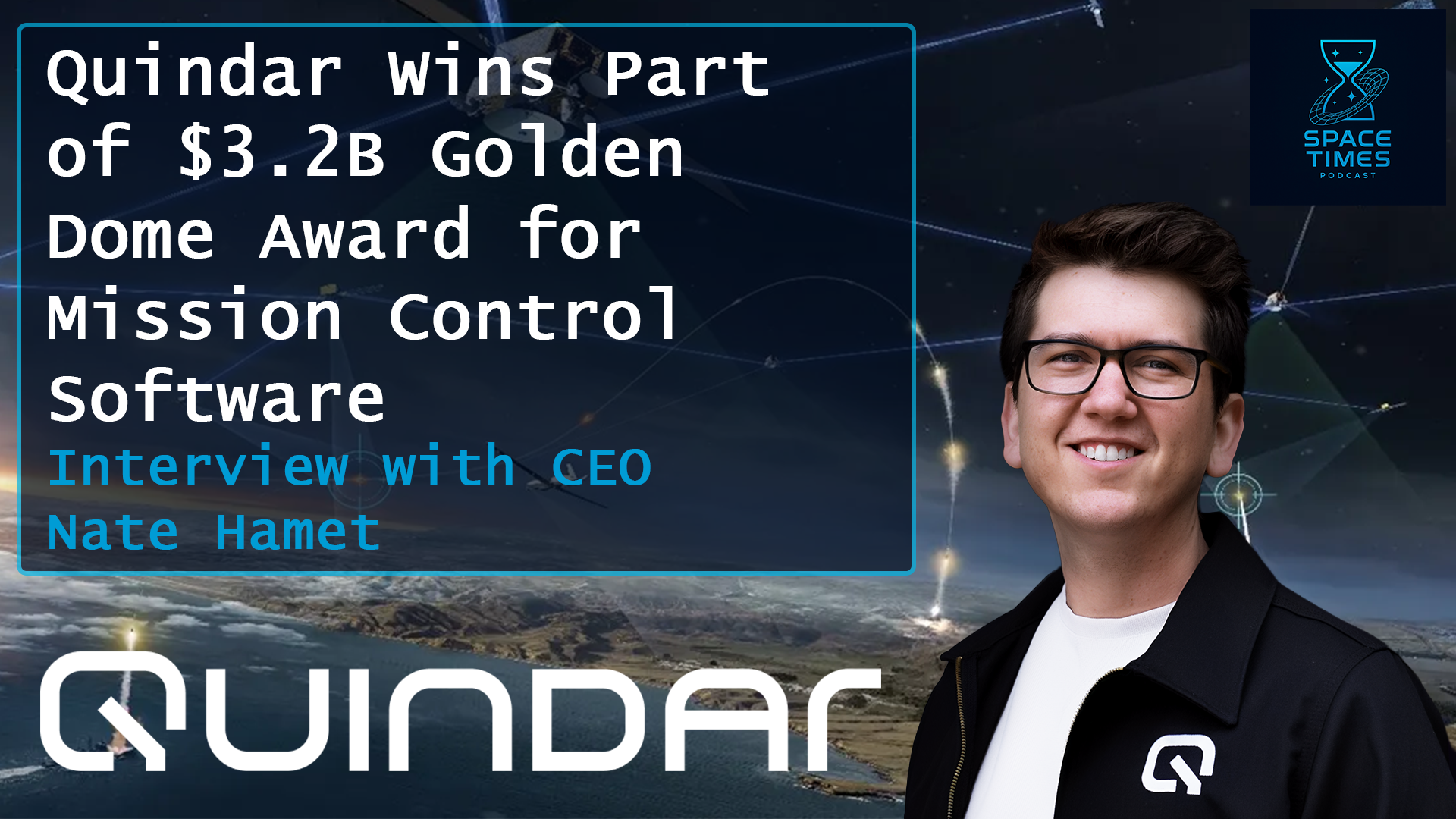
Quindar won part of a $3.2B Golden Dome contract because of their speed, agility, and commercial heritage
Space has been a slow moving industry, operating on years-long timelines to reduce risk to expensive one-off space missions. They often sit in one place with the ISS constantly boosting to stay in its orbit, or GEO satellites hovering over one spot for 15 years, or rovers entombed on other planets. New Space has picked up the pace, and we are entering a phase where the industry is rapidly scaling, with more satellites, new types of missions, and more flexible operations. The operational systems developed for GEO communication satellites will not work for a communication megaconstellation in LEO, and those new systems likely won’t work for the next types of architecture. Stalwart players like Echostar and Globalstar have shown how costly it is to adapt to new trends, and have ceded much of their business to newer entrants like SpaceX and Blue Origin. Implementing a system that shifts to meet changing needs becomes necessary to keep up with the evolving environment of the industry, and Quindar provides that to space companies to ensure they are operationally ready for whatever the next mission is.
Megaconstellations have amplified the demand for better automation, an operator for each satellite doesn’t scale to thousands of satellites, as CEO Nate Hamet puts it “if you see mission operation centers there’s tons of screens…a lot of people there…but the bad part is it really hasn’t evolved too much and people solve it with other people. And you can’t solve it that way when you’re proliferating a constellation.” This is the problem he solved at one of the first large communication constellations, OneWeb. Foreseeing the same challenge being tackled over and over at all the other companies building constellations led him to realize that it’s inefficient for the industry if everyone is solving the same operational issues, leading him to create Quindar as a universal solution. That solution has five core components: Plan for mission planning, Flight for flight dynamics, Control for command & control, Event for fleet monitoring, and Portal for cross-team management. Together they accelerate the creation of operational systems for their customers by providing integrations to an ever-expanding catalog of partnerships with suppliers of everything from components to ground stations. These managed connections enable automation that reduces overhead for development, management, and operations enabling spacecraft providers to focus on building their core capabilities. Many companies are starting to expand their core offerings to add new revenue streams, and having an automated platform that can adapt along with them will make growth quicker and profit margins larger. For example, communication constellations like OneWeb, Kepler, and K2 have started selling hosted payloads as a complementary service; this additional mission complexity is non-trivial and further requires the sorts of tools that Quindar provides. Kepler has even flown Axiom’s orbital data centers as a hosted payload already which is an early move for the emerging market that already has over a million satellites filed for launch. At such scales, the need for automation is non-negotiable, so Quindar’s Control product enables operators to 100x their fleets without 100x’ing their staff.
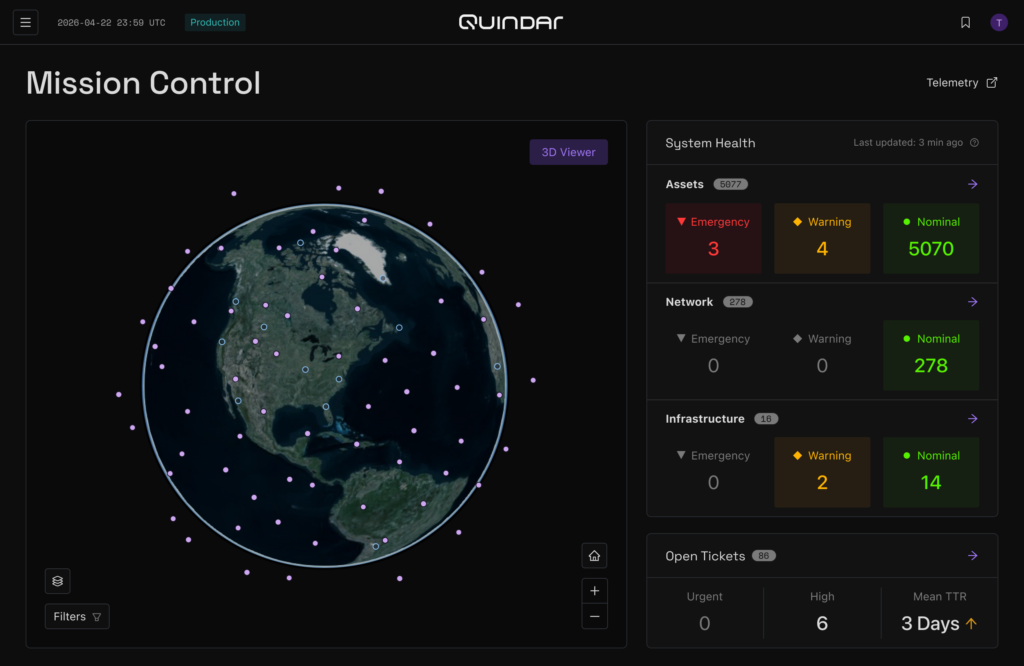
Modular buses face a similar challenge as hosted payload platforms, and are growing in quantity supported by other large scale applications like imaging, microgravity manufacturing, and space based interceptors. They haven’t yet proliferated at the same scales as communication applications, but even with small numbers they face many challenges when it comes to adapting to their variety of payloads and mission profiles. Imagers come in a variety of flavors like multispectral, synthetic aperture radar, very low earth orbit, and space situational awareness all with dramatically different modes of operations. Having one bus that can accommodate all these different applications requires integration with a variety of payload suppliers, adaptable systems for different modes of operations, and resilient communication systems to provide data in a timely and reliable fashion. To make things even more complicated the microgravity manufacturing and space based interceptors sectors add the complexity of re-entry, which is why they need planning software that can manage the added risk. For a sense of scope of this demand, just this month the US Department of Defense has allocated over $2B dollars for battlefield planning software from Leidos, MapLarge, and Palantir to coordinate all their assets. This comes a week after the OCX program led by Raytheon to coordinate next generation GPS operations was shut down after spending $6B and delivering a non-functional system. Taken together it’s clear the US DoD has adjusted their focus to new approaches from younger companies to tackle challenging planning software with a “speed that [Quindar] can provide because of the product, because it’s integrated with…amazing partners…that shrink it from 12 years down to, in some cases on the unclassified side, integrated with an orbit satellite in 23 days”. Capitalizing on this shift, Quindar has won many US DoD government contracts to provide software to manage complex and large-scale space projects. They are taking what has been done commercially with Quindar Plan to help the US government easily implement it into their most challenging systems.
Not all of the conflicts being addressed by space assets are coming from Earth though, threats from ever-increasing amounts of debris, and even adversarial spacecraft, have become a real concern. In-orbit servicing is a growing capability intended to extend lifetimes of spacecraft to decrease the number of defunct objects floating around just waiting to collide with their neighbors. When they finally are ready to be decommissioned (or even when they’re not ready in the case of adversarial satellites) there is an increasing number of spacecraft capable of rendezvousing and dragging their target out of orbit. Optimizing the operations of in-space logistics is key to allowing this new infrastructure to grow efficiently. Starfish Space is one of the early players in this sector with a spacecraft that is highly maneuverable and able to capture other satellites. The complexity of such operations is significant, requiring coordination between two satellites that may not be cooperating in joint maneuvers. As Nate explains it “these various manufacturers have different form factors, different personalities, different operating software. So it’s not just as easy as hey we got all these satellites together. You’ve now created a language barrier between all of them and there’s no single mission management solution that can work across these”, until Quindar. Having such dynamic missions requires rapid adaptability, something Starfish is very familiar with the recovery of their tumbling Otter Pup 1 and changing orbits after losing their target spacecraft for Otter Pup 2. So it’s a resounding endorsement that they selected Quindar as their mission planning provider. Starfish has their own role in US DoD operations as they won a contract to de-orbit a PWSA spacecraft, and Quindar’s Portal offering will help support coordination between the multiple stakeholders invested in proving out such an advanced capability.
The implications of Starfish’s success is beyond the stated goal of de-orbiting debris though, as such a capability can be used to defend US space assets against attack from adversarial spacecraft such as China’s Shiyan demoed last year, or Russia’s Luch demoed two years ago. The first layer of defense is already being rapidly deployed with the DoD spending $1.8B on the Andromeda program this past month to drastically expand space-based situational awareness, and another $3M contract for counter-surveillance tech against radar monitoring. Once a threat is detected, a defensive spacecraft needs to be rapidly tasked with response, traditionally referred to as command and control (C2). Quindar is very familiar with these sorts of operations as they’ve been providing it to the USAF since last year. While focused on terrestrial C2, they are gathering the components needed for the next stage of space domain defense through their work with commercial and government systems. This is the pattern that was most interesting as we talked with Nate, Quindar is able to develop new capabilities through their contracts, so that when the next customer comes along they don’t have to start at zero; instead they’re able to keep ratcheting upon their successes and allow disparate players in the industry to propel each other forward.
Space will continue accelerating in its expansion, there’s still extensive work to be done around Earth, but NASA and the USSF are taking us back to the Moon, and SpaceX is still pushing for Mars. Quindar has identified a critical component to drive that expansion, and are building a flywheel that makes it easier and easier for their customers to tackle increasingly challenging and dynamic missions. If you’re a company that operates or supports such operations then be sure to reach out to Quindar at info@quindar.space.
Watch the full interview on our YouTube channel!




Leave a Reply