
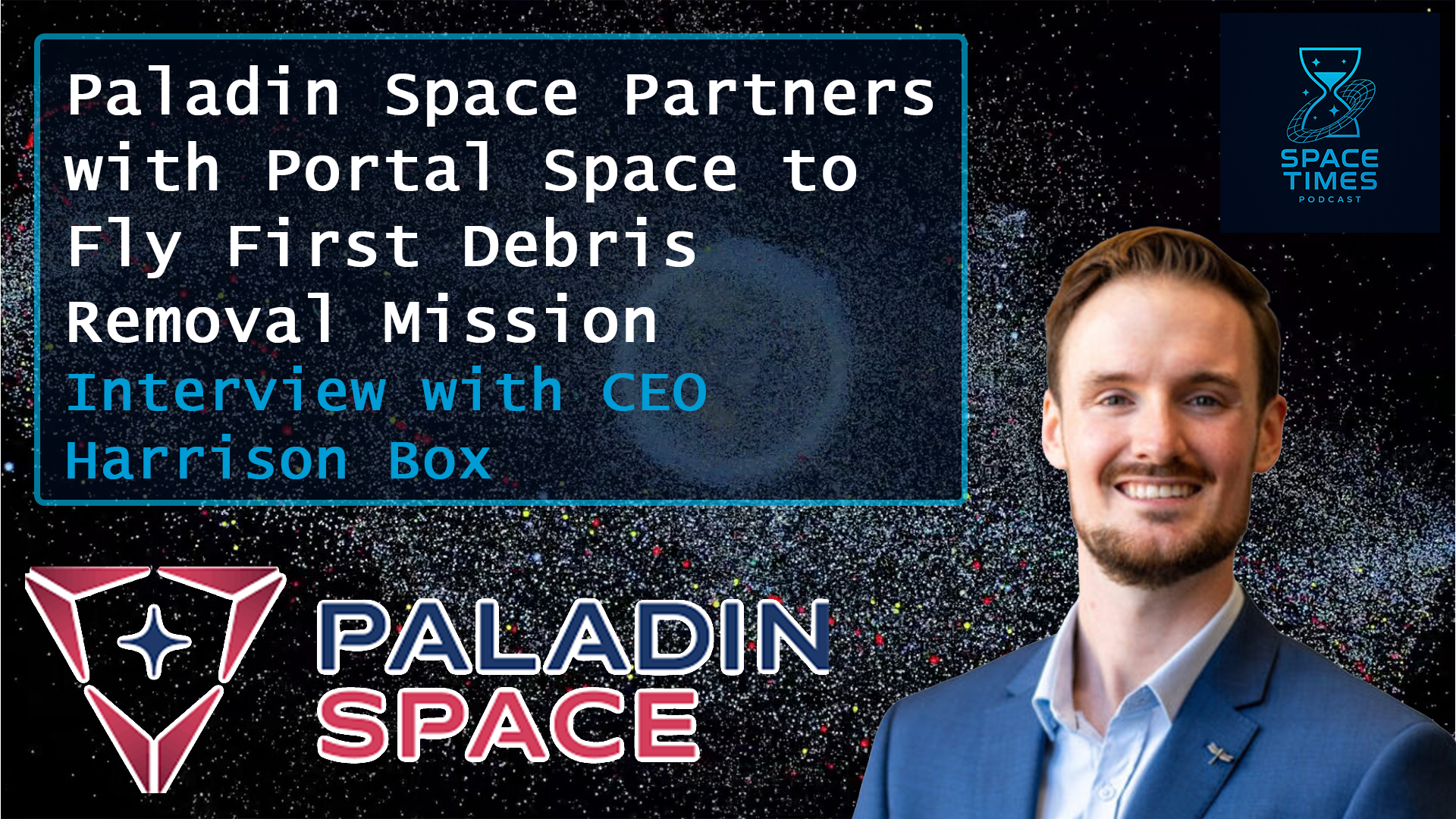
Paladin Space partnered with Portal Space Systems to launch their first satellite to capture multiple pieces of debris to clean up orbits
On Earth we’ve long recognized that tossing our trash in the street is not a sustainable waste management strategy, and the companies that handle it properly are quite profitable. In space, we seem to have not learned that lesson yet. Governments have improved restrictions on de-orbit timelines, but even then, would you be happy with garbage being left on your sidewalk for 5 years? In space it’s not just a nuisance, but a danger. The warnings of Kessler Syndrome are a long-held argument for the need for a better solution to keeping our orbital environment clean, but even in less catastrophic scenarios, debris is still a very real and growing risk for satellites. Paladin Space isn’t waiting for the worst case scenario, instead they’ve partnered with Portal Space Systems to launch a satellite that’s highly maneuverable and able to collect multiple pieces of small debris that are actively posing risk to our growing on-orbit infrastructure.
The number of satellites in orbit five years ago was 4,000, today it’s above 15,000, and with numerous constellations filed for launch we are headed for 2,000,000. Even before we reach millions of satellites in space, we’ve already achieved millions of pieces of debris. Most of those are under 10cm in size, but so is a bullet, and they travel at much slower speeds than objects in orbit. The vast amount of debris and their high energies combine to create an increasingly risky environment for spacecraft to operate in. For a sense of scale the Starlink constellation had to perform 144,404 collision avoidance maneuvers from December 1, 2024 to May 31, 2025. Yet, even when collisions are avoided, we can’t avoid events that generate more debris such as the destructive event of a Starlink this week that created tens of new pieces of debris. This satellite wasn’t even one of the over 4,000 satellites that SpaceX lowered following the last destructive event in December. That dramatic mitigation strategy was intended to reduce the resulting effect of a collision by minimizing the on-orbit lifetime of the resulting ejecta, but it also reduced the lifetime of the satellites creating a significant reduction in profits. This is not a long term solution for the problem, since we can’t just keep all satellites at low altitudes.
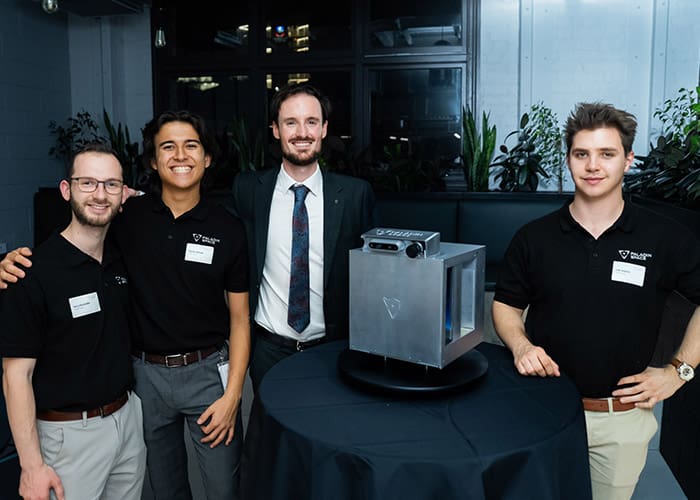
Paladin Space is addressing the issue more directly with their active debris removal payload Triton. Triton is a box shaped container that can be used to scoop up debris until it’s full. This is a divergence from the claw shaped design that has been popular for other debris removal companies like Astroscale and Kall Morris, but as CEO Harrison Box emphasizes “our system and our solution is a complimentary service to the other players. I’m not suggesting that ours is the only one to solve this problem. It’s just the best solution for small debris and they’ve got the solution for large debris and we need each other both to survive.” The benefits of the box design for small debris are numerous. The spin rate of its targets becomes a non-factor so it doesn’t have to spend fuel and time matching the rotation prior to capture. The box can be ejected once full, and be replaced with an empty one either from onboard or a resupply vehicle. The payload that holds the box has sensors to classify objects and provide guidance for near-field operations that don’t have to be replaced with each new box. And it is flexible in its ability to scale up to a meter in size, and integrate with any spacecraft bus. To start though, they’re partnering with Portal Space Systems because as Harrison explained “…we don’t believe the limiting factor to our debris removal missions will be the volume inside our unit to collect debris. We think the limiting factor will be delta-V…So with portal space, we have that taken care of.” Equipping a highly mobile spacecraft with their Triton payload opens up many business opportunities that will allow them to achieve the fleet scale needed to make an impact in the massive amount of debris on-orbit, and allow them to service constellations, human habitats, defense assets, and more.
Constellations are the biggest financial opportunity being the largest scale deployments of satellites that are often co-located in a specific orbit. Even with a high delta-V vehicle to move around, the most efficient maneuvers are moving around within an orbit rather than changing orbits, so the cost efficiency is ideal. The best thing about this paradigm is that the value isn’t some nebulous calculation about improved safety, but rather concrete operational savings that justifies the cost of their Debris Removal as a Service (DRaaS). Harrison explains that “our unit economics basically become a metric of how much fuel life we’re extending…if one collision avoidance move takes you 5 km up then 5 km down, you’re using argon fuel, and your satellite is 800 kg, we can very quickly figure out exactly how much cost that is costing them to make that collision avoidance. So if we say we’re saving them 20,000 [avoidance maneuvers] then boom we’ve got a $150 million saving per year.” Those fuel savings will allow constellation operators to keep their satellites in orbit longer, and services can have higher uptime if they’re not having to pause for collision avoidance maneuvers.
Space habitats benefit from these savings as well, with the additional benefit of safety for human inhabitants. Last year China’s Shenzhou capsule was struck by orbital debris stranding three Taikonauts aboard the Tiangong station, luckily nobody was injured, but these kinds of space operations shouldn’t depend on luck. The need for preemptive cleanup of orbits occupied by space habitats will be an emerging need in the next 5 years as the ISS is decommissioned and private habitats like Axiom’s Station and Vast’s Haven are deployed. Even now the value of Paladin’s service is being recognized by Voyager Technologies, who have signed an LOI to use DRaaS to protect their upcoming Starlab habitat.
Anti-satellite missiles have historically been the largest contributors of small debris, and while there hasn’t been a strike in a while, the defense sector of the space industry has been making very clear their need for RPO capabilities to protect against future threats to spacecraft. Companies like Starfish Space and Katalyst have received contracts in the past months to service and de-orbit friendly spacecraft, though it is reasonable to interpret these capabilities as dual-use for manipulating adversarial satellites. This is another way that Paladin could receive revenue to further their debris removal efforts, as Harrison noted “…this tech can be used by defense as well to capture a variety of different threats and maybe even perform retrieval missions as well because as a result of this payload being essentially a box, there can be shielding put on this box for custom defense mission. They can capture things in orbit like a fragment of a server or a part of a satellite from an adversary state. You can capture that and bring it back and that kind of business model for us doesn’t require any partnership with any bus provider. We simply give the payload to the defense [department] who already have the satellite doing the RPO and they’ve now got this tool in their belt.” With two LOIs already in place with defense players, this is proving to be an in-demand line of business to complement their core offering.
Another potential revenue stream down the line is the recycled materials market. Harrison pointed out “There’s 9,000 tons of debris in orbit as we currently speak right now. So in 5-10 years, can you imagine how many tons there will be then?” Instead of just returning captured debris to Earth, Paladin could instead use this debris to provide raw material to a circular space economy. On-orbit manufacturing is still in its nascency with Varda being the furthest along with their sixth launch this week, but it is projected to be one of the largest markets for the space economy, and would be the most obvious consumer of recycled material. And with NASA’s recent Ignition announcement, lunar habitation is going to increase in priority, serving as another potential beneficiary of this capability. As long as the debris is contained and removed, it’s mission accomplished for Paladin, but it’s a fascinating thought that their system could help make space self-sustaining!
Paladin’s unique approach to active debris removal, and the business model it enables, is the sort of solution needed to address such an expansive, pressing, and challenging problem. The sooner they can get to orbit and start cleaning up space, the better; not just for decreasing operational risk, but to establish a more sustainable way for spacecraft to proliferate. Luckily Portal will help them get to space in 2027 and begin cleaning our orbital streets! If you’re interested in learning more about debris removal, or using DRaaS to protect your space assets, be sure to check out Paladin Space.
The full video interview with Paladin Space CEO Harrison Box can be found on our YouTube.
If you are a space company with exciting news, Space Times would love to talk! Please email contact@spacetimespod.com to discuss how we might provide media coverage for you.




Leave a Reply