
Atlas Cup is turning spacecraft racing into the next big sport with $1M prize
There have been space races before: between governments through the Cold War, between companies since the early 2010’s, between rockets in 2009, and in countless films and media. Competition has been a driving factor of innovation as it captures the imagination of the masses, taking an industry that is historically shrouded in secrecy and ITAR protections and bringing it into the coliseum of public fascination. Now, Atlas Cup is firing the starting gun on Space Race 3.0, pitting the growing number of unique spacecraft against one another in races tailored to test their speed and agility, and accelerate the development of capabilities.
Space as an industry kicked off at an incredible speed, international competition saw the Explorer spacecraft launched by America just 119 days after Sputnik launched in 1957, and within 12 years America had placed a man on the moon. Victory may have defeated ambitions though as what followed was decades of sluggish innovation, though there were notable accomplishments through cooperation in the form of space shuttles and the international space station, it wasn’t until SpaceX was formed to again compete with Russia that launch development reignited. Over the past fifteen years, Space Race 2.0 has birthed dozens of new launch vehicles that opened access to space for hundreds of satellite companies. The competition that emerged in that sector has primarily been over contracts, and as governments and commercial customers have selected winners and losers, we’re starting to see a contraction in the number of solutions that are surviving in this market. While commoditized buses from large primes and successful startups are dominating, and hall effect thrusters have become the preferred method of propulsion, there still exists exciting technology that might not be pulling in money now, but will be critical to our growth as an interplanetary species. Orbital transfer vehicles, electrospray thrusters, formation flying constellations, and nuclear propulsion are just some examples of capabilities that are needed to explore the moon and Mars and mine asteroids but are lagging behind megaconstellations and cubesats. As Philip Hover-Smoot, Founder and CEO of Atlas Cup, sees it, building an arena to spur the growth of cutting edge technology is a driving force behind the demand for space racing as a sport “There’s a million indicators of interest in racing and competitive activity in space. We just haven’t done it, which is bizarre because everything necessary to do this already exists in spades with multiple proven vendors. There’s no reason this can’t happen today.”

Atlas Cup is starting today with sprint races, time trials, and a $1 million purse! The races will standardize across different thruster classes and orbital courses, ensuring countless entertaining formats. A 400N Draco rocket won’t be competing against a 100mN Hall thruster, and the courses will be designed in a way that competitors can’t just drop altitude to pick up speed. Those constraints are what may set the players free though as Philip envisions this sport to appeal to a number of different audiences: satellite operators whose spacecraft are near end of life and may want to eke out another million dollars as they de-orbit, bus manufacturers who want to demonstrate the limits of their performance, and universities that are developing cutting edge technologies to push the state of the art forward. The university aspect is particularly interesting as historically schools have played a key role in partnering with industry such as in the development of the popular Cubesat standard, and racing teams like Formula SAE are where many students turn their childhood fascinations into real world experiences. Atlas Cup is “already in discussion with a number of university aerospace engineering programs about having the college version of these organizations, [there are] 30-40 programs across the country that are already building satellites on a regular basis.” To enforce standards and sportsmanship across all these different players and race formats, Philip also formed the Fédération Internationale des Sports Orbitaux (FISO), a regulatory agency to specify the rules of the game much like FIA does for Formula 1, and ensure safety for both the competing spacecraft and the broader space environment. With a background in orbital transfer vehicles at Momentus, space launch at the aptly named SpaceLaunch, and space domain awareness at Scout Space, Philip has all the prerequisite experience to ensure the sport is safe and fair as well as entertaining.
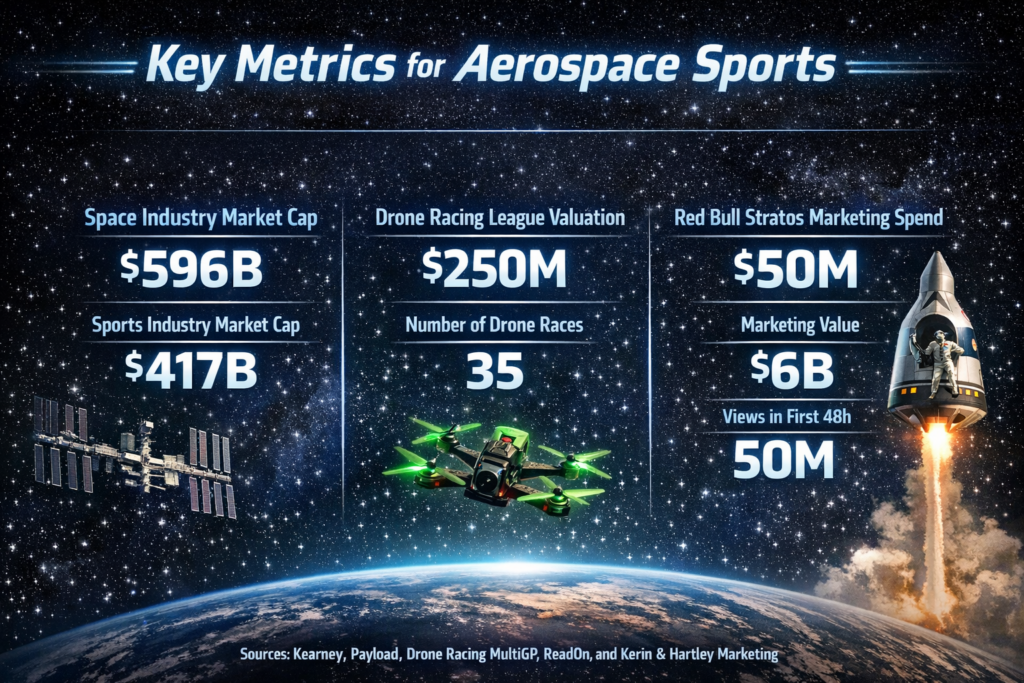
Entertainment will come in the form of long form and short form content consisting of high definition video from cameras onboard the spacecraft, and ideally third person from chase spacecraft, graphic visualizations, and background content on the teams of smart people that design, build and operate the spacecraft. The financial opportunity is significant as the market for sports at $417B (Kearney, 2024) is comparable to the market for space $596B (Payload, 2024) with crossovers that are rare but not unheard of; the Drone Racing League is perhaps the closest parallel to Atlas Cup and it was sold in 2024 to Infinite Reality for $250M. The fact that there aren’t many analogs to what Atlas Cup is doing is part of what makes it exciting, it’s a brand new vertical of the space market that has the potential to add a new source of revenue for an industry that is hungry for capital. The opportunity, like most things in space, is vast since there’s no telling what adjacent markets can spawn from space race content: events, merchandising, lunar buggy racing? As regular civilians fly to the edge of space in rockets, commercial space habitats plan to replace the ISS by 2030, and humanity verges on becoming an interplanetary species, the connection everyday people have to space is only going to grow. Atlas Cup is positioning itself to capitalize on that by building “something just wild that has this sense of inevitability, like yes challenges there’s a lot of work to be done there’s so many things to go figure out, but this is as inevitable as many of us believe.”
To learn more about Atlas Cup, visit their website https://www.atlascup.com/, follow their socials, and subscribe to their newsletter. To hear more about the Spacecraft Grand Prix, lunar basketball, space station fights, and the future of space media, subscribe to Space Times Podcast so you can watch our full interview with Philip Hover-Smoot later this week.
If you are a space company with exciting news, Space Times would love to talk! Please email contact@spacetimespod.comto discuss how we might provide media coverage for you.






Leave a Reply