

Portal Space Systems Selects Atomic-6 to Shield Their Critical Systems with Space Armor
Space has, as the name suggests, a lot of space; ~1 trillion km3 of area in LEO, the most popular of orbits. Speeding around in that region is hundreds of millions of pieces of debris that are untrackable due to being too small, between 1mm to 1cm. With so much room it may seem unlikely these objects would bump into each other, but that’s exactly what happened last month to the Shenzou-20 capsule, jeopardizing the lives of the Taikonauts aboard the Tiangong space station. As the number of satellites in LEO grows, so will this problem. There have already been 148,696 avoidance maneuvers performed over the last 6 months for 9,000 active Starlinks to avoid the other 16,000 trackable space objects, and with more than 50,000 satellites planned to be launched to that region between Starlink, Guowang, and Qianfan it will become increasingly difficult to avoid collisions. There are plenty of companies working on keeping satellites away from each other, but there are also plenty of other companies working on bringing satellites closer together. Whether for docking to space habitats, in-space assembly and manufacturing, refueling, formation flying, or RPO for friendly or adversarial operations; these are all growing demands in the space industry. The proximity of these operations increases the chance of collision, increases collision areas, and decreases agility to avoid collisions; so if the nature of the operation increases chances of collision, then the need for better protection becomes critical. That’s the problem Atomic-6 has been developing solutions for, including Lightwing for more flexible and lower-profile solar arrays, and Space Armor to protect critical spacecraft systems like that of Portal Space Systems’ Starburst-1.
Space Armor is an evolution to the traditional approach of Whipple shielding that’s been around since 1946. Whipple shields are spaced layers of aluminum plates that slow debris as they pass through each layer until it’s stopped somewhere in the gaps. The ISS is the primary user of this technology since the safety of the human inhabitants is critical, and the mass and size impact are less prohibitive than for smaller, more expendable spacecraft. Atomic-6 has developed an upgrade in the form of a composite plate that saves mass, has a thinner profile, is modular, and not only doesn’t generate additional debris on impact, but actually captures the debris that hits it! They currently have two levels of armor, Lite and Max, that stop debris up to 12.5mm going up to 7.2km/s, which covers orbital speeds for LEO and the size of those hundreds of millions of untrackable debris. Their first flight is as part of Portal Space Systems’ Starburst-1 mission planned for October 2026. Starburst-1 is a rapid maneuverability spacecraft planning to perform RPO operations which will put it in situations where it’s more likely to be hit by debris. “They are going to be flying the tiles on there and they’ll have cameras…you won’t see the moment of impact because the projectile will be moving too fast but you will see the before and after and you can compare the telemetry on the spacecraft to see if anything bad happened” explained Trevor Smith, CEO of Atomic-6 during his interview with Space Times.
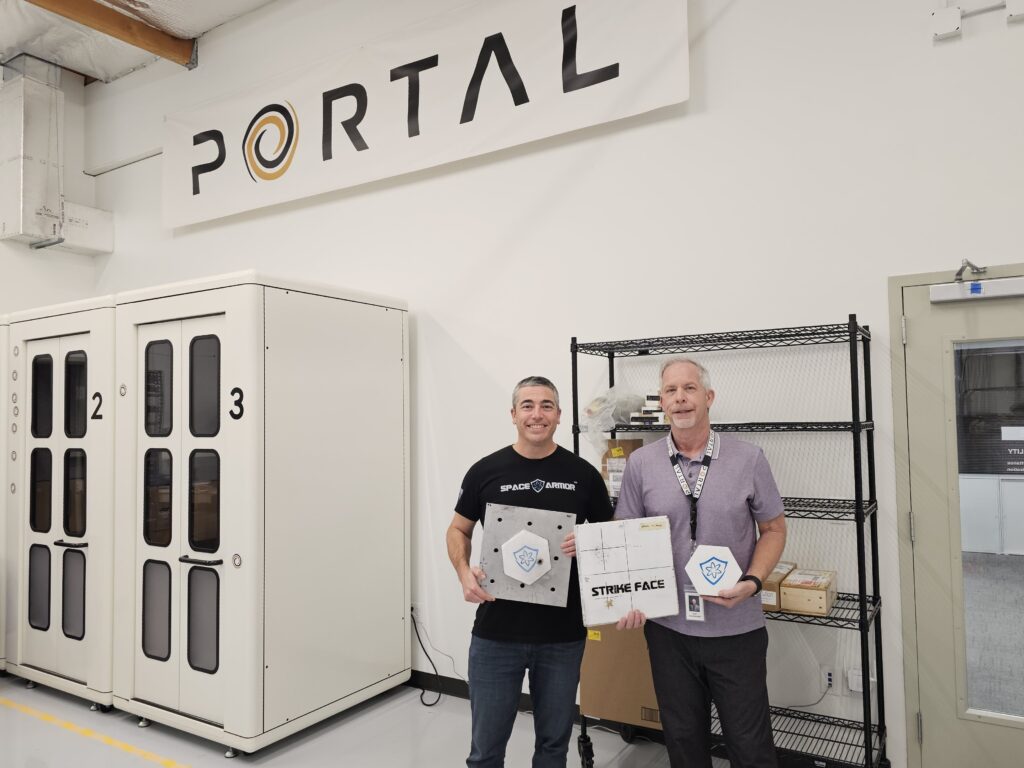
The attributes of Space Armor make it an ideal solution for adding resilience wherever it’s needed, being flat and light means it can be added to any existing structure or surface with minimal change to design or mass budget. It can be made either RF transparent or opaque, allowing it to double as a faraday cage, or protect critical communications equipment without interfering with its operation. And its modularity makes it adaptable to any spacecraft and enables the potential for replacement on-orbit: “We’ve had some customers ask, ‘Well, if we get hit and we had a robotic arm, could we apply another tile in space with this robotic arm and just put it over the the one that got hit?’ Absolutely. That’s why it’s made in a tile form.” While all these traits make it ideal for the LEO environment, there’s lots of potential in other domains including GEO where we saw RPO demos last year as well with the Shiyan-Shijian satellites, and a costly debris strike last month with SpainSat NG II. Atomic-6 is even heading to lunar orbit with Sidus Space and Lonestar Data Holdings to build orbital data centers leveraging their Lightwing technology, which uses their composites expertise to deliver industry-leading power-to-mass ratio, and unique retractable solar array design. “If you wanted to press the gas pedal and get somewhere really fast, today’s solar arrays would rip off because of the inertia at full deployment. So, the idea is you retract your arrays, press the gas pedal, and then redeploy once you get to where you’re going.” We can’t wait to see where Atomic-6 is going next, because with revolutionary products that save mass and the spacecraft, surely they’ll go far!
To learn more about Atomic-6’s products and services check out their website, or contact them at adam@atomic-6.com. To hear more about protecting spacecraft from debris, enabling data centers for the moon, and all the other cool stuff that Atomic-6 is working on, subscribe to Space Times Podcast so you can watch our full interview with Trevor Smith coming out next week.
If you are a space company with exciting news, Space Times would love to talk! Please email contact@spacetimespod.comto discuss how we might provide media coverage for you.







Leave a Reply