
Space Phoenix announced $7.5 million secured for their seed round closing this month, Flawless Photonics as a new customer, and plans for their inaugural launch next year during their interview with Space Times Podcast! Watch the full episode to hear all the details from CEO Andrew Parlock, or continue reading for Space Times’ summary of their business case.
Gravity is an ever present detriment to growth on earth, it pulls on everything, and at an atomic level that causes imperfections. This means less efficient semiconductors and solar cells from crystalline defects, and strained structures in biological systems; so what if we could remove gravity? While we can’t remove Earth, we can get far enough away that its physical draw becomes trivial. Scientists have been doing this on the ISS for a couple decades now and proven repeatedly that crystals grown on orbit improve semiconductors, fiber optics, solar cells, medicine, and more. Now we’re ready to scale from lab tests to mass manufacturing, which introduces all the other challenges of operating in space. And that’s why Space Times is so excited to talk to Space Phoenix about how they are going to solve those challenges to enable manufacturing anything at scale in microgravity.
“You can’t manufacture on the ISS. Remember that, even today you cannot manufacture on the ISS. You can only do applied fundamental and applied research” emphasized Andrew Parlock, CEO of Space Phoenix, during his interview with Space Times Podcast. While not a manufacturing facility, the ISS is the largest scale space operation to date, a permanently occupied outpost in Low Earth Orbit that is expertly managed by NASA. To avoid catastrophic failures, and ensure seamless operation, they’ve had to master the logistics of sourcing components from hundreds of companies, performing testing and integration on Earth, managing assembly on orbit, coordinating launch and return of personnel and supplies, and doing it all perfectly for over 25 years now. Space Phoenix will become the logistics provider for commercial microgravity manufacturing much the way NASA is for the ISS, but as Andrew explains it, more akin to FedEx for space: “We’re white glove third party logistics…We’re going to manage all the space aspects of it. We’re going to pick your payload up. We’re going to get you integrated onto a spacecraft. We’re going to manage the launch. We’re going to get a company to integrate you to the launch vehicle. We’re going to manage the operations in orbit. We’re going to get you back down. We’re going to manage the recovery. And we’re going to deliver the final product to you.”
Space Phoenix started solving this problem 18 months ago, and with the raise of $7.5 million for their first round of funding, they are ready for their inaugural launch in Q2 of 2027. That launch will carry their Hermes capsule to orbit, the smallest orbital return capsule available on the market at a modest 170kg, and a payload capacity of <60kg. This small size allows it to launch on almost any rocket, which overcomes the launch cadence challenge. The downside to that solution is that the cost ratio of the support systems to the payload is higher, representing lower margins. Andrew explained plans for larger capsules, but it should be noted that the profit margins are high enough in most use cases that even producing <10kg would be lucrative.
Data published by Factories in Space indicates that the fiber produced from space-based ZLAN would sell in the range of $600K/kg to $3M/kg, representing a premium of between $300K/kg to $2M+/kg compared to prices for ZBLAN produced by Earth-based manufacturing. Thus, transport costs of $1K/kg to $10K/kg are far outweighed by the premium achieved through space-based manufacturing.
ChainLink Research
This means that a single customer like Flawless Photonics could pay back their investments on the first flight alone, and the rest of their customers would allow them to self-fund their future operations and growth. With 750 experiments backlogged on the ISS (planned to de-orbit by 2030) any number of them could fuel that growth, and they are well positioned to pursue those opportunities with the recent addition of former ISS Lab director Dr. Rose Hernández to their team.
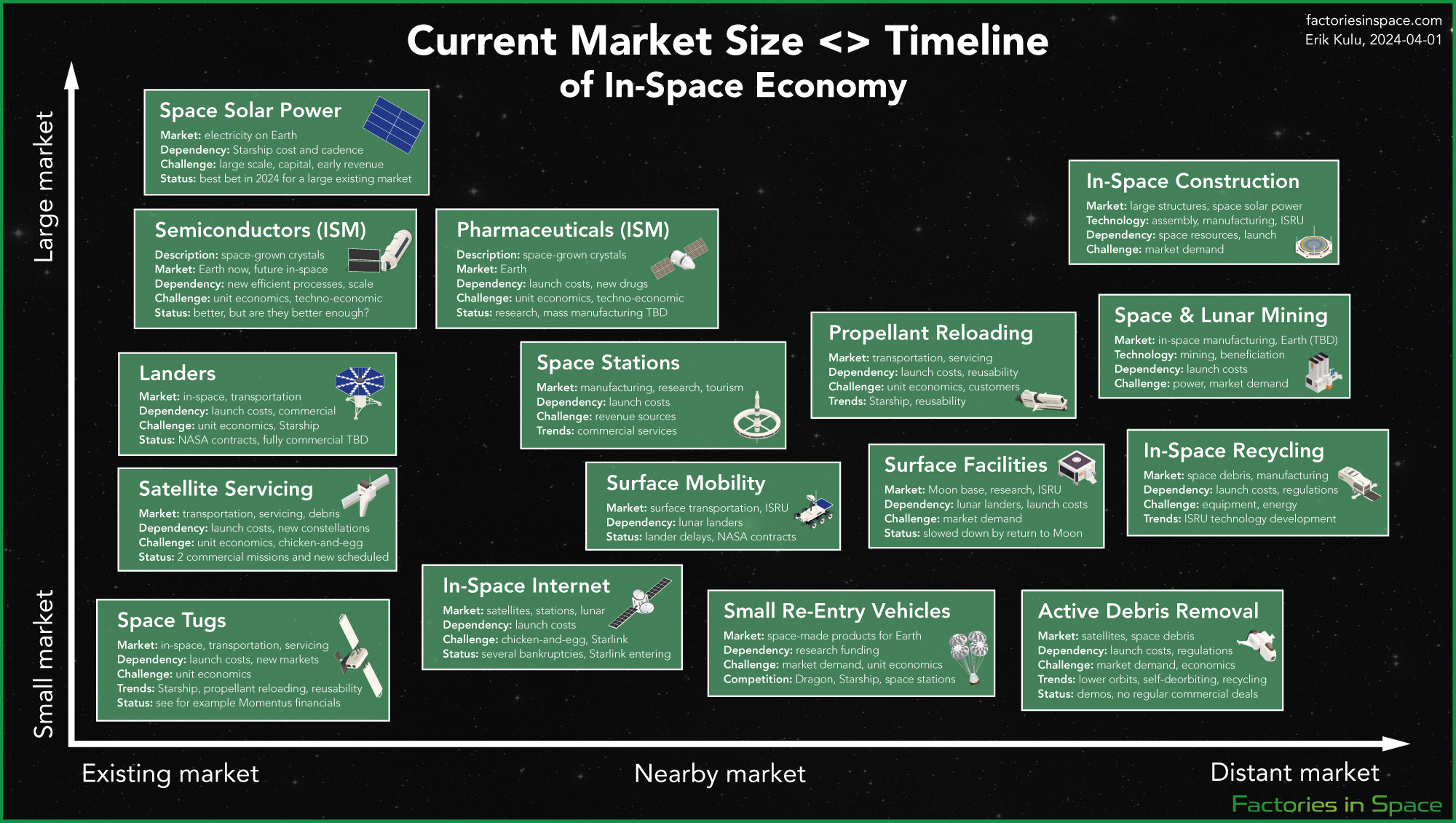
In-Space manufacturing is poised to be a significant and growing market this year with Varda launching their fifth mission on TR-15 in late 2025, and Space Forge just this week announcing success with their furnace capable of producing crystals at 1,000°C for semiconductors. Long term, the growth potential beyond Earth based applications is unlimited once the demand for in-space resources arrives with the production of large scale space infrastructure like data centers, solar farms, and lunar habitats. However it plays out, Andrew is confident that Space Phoenix is ready ”…because a lot of folks have made bets that the market is going one place or another, but it’s not there yet. We’ve bet small and developed a roadmap to get bigger.” With Andrew’s tenure in aerospace and business at Northrop Grumman, ICEYE, Space Forge and more, he has been able to assemble a leadership team full of experienced operators to ensure Space Phoenix can execute on that roadmap. If you’d like to invest in their success, join them in solving their exciting challenges, or have a product to manufacture in space, then reach out to connect@space-phoenix.com.
If you are a space company with exciting news, Space Times would love to talk! Email contact@spacetimespod.com to discuss how we might provide media coverage for you.







Leave a Reply