
With TRL9 from their second flight, Zenno is ready to reshape how spacecraft handle everything from controls to radiation shielding
If magnets seem like magic, then superconductors seem like super-magic. The super-wizards that understand it are co-founders Max Arshavsky and Sebastian Wieczorek, who spun Zenno Astronautics out of the University of Auckland to bring their superconductor research to the commercial market. Why would they do this? Well one of the main benefits of a superconductor is the order of magnitude increase of magnetic field strength over a ferromagnet of comparable size. The main drawback is it needs to be cooled to -200degC. They solved the cooling problem with their Supertorquer, flew it on Impulse’s Express 3 mission, achieved TRL9, and are now ready to electrify space.
That electrify space catch phrase is an interesting one as it highlights the fact that they can provide control over a spacecraft without the need for fuel, much like electrifying a car. They’re primarily referencing the need for thrusters to desaturate reaction wheels in GEO, but all that goes away with their Supertorquer. Not only can they use their Supertorquer in GEO where the magnetic field is too weak for this solution with weaker magnets, but it can replace the reaction wheels as well as the desaturation actuators because it can induce enough torque to actually rotate the spacecraft. Their Supertorquer can provide 20x the torque of a comparable magnetorquer, which is why it can work from LEO all the way out to GEO. Because there’s no reaction wheel, their solution also removes a significant source of jitter. And their cryocooler is so good that they can run steady-state indefinitely.
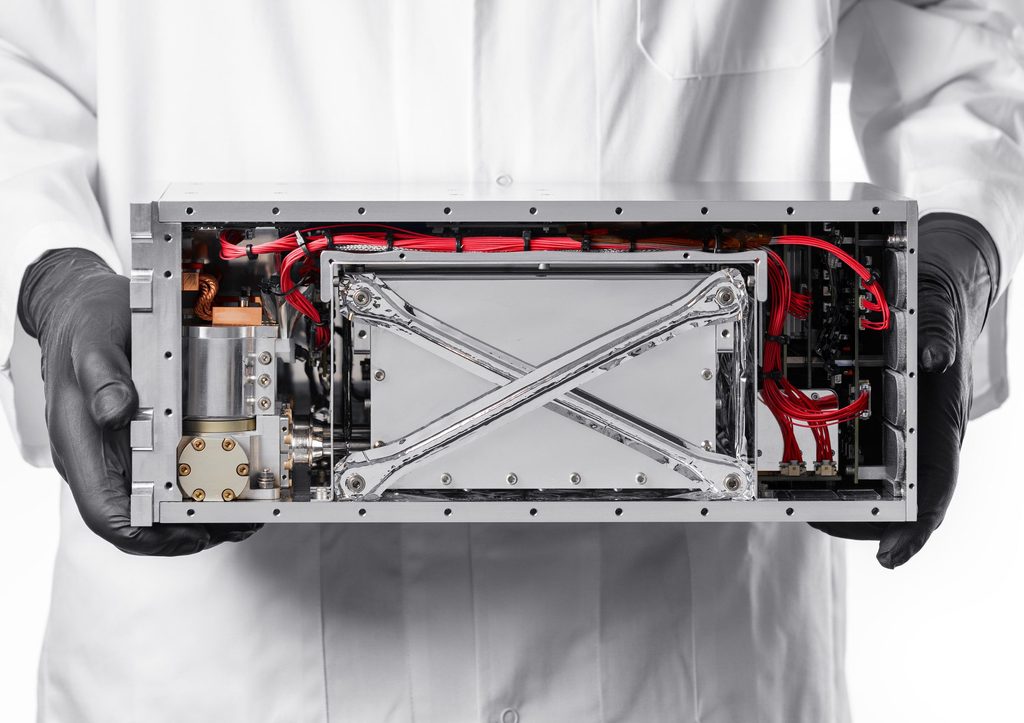
Already this solution upends one of the most critical and unchallenged components in any spacecraft, but it’s the side effect that Sebastian gets “most excited about—creating a magnetic force field around something to shield it from charged particle radiation.” Much like the Earth’s magnetic field shielding us terrestrially bound beings from the Sun’s harmful radiation, their generated magnetic field can deflect the charged particles away from the host spacecraft. This use case alone is worth its weight in superconducting material as the need to protect against radiation is becoming exceedingly critical with the boom in demand for orbital data centers. Traditional radiation shielding is another component of spacecraft that hasn’t changed much over time; it relies either on heavy shielding, costly rad-hardening, or constraining oneself within the Van Allen belts. Even more critical to protect than a GPU, are humans, another spacecraft component that’s venturing out into space with increased frequency. “Another thing is space stations. Electromagnets scale very well with size. The bigger they are, the better they perform and the more efficient they are to cool. My dream would be to get one of them on a private space station popping up to replace the ISS early next decade.” Space stations need control too, so utilizing Zenno’s tech provides the dual benefit of protecting their squishy payloads while replacing their large CMG actuators.
As people venture further out into the solar system, the support systems needed are going to result in many multiples more mass than the people that use them. Moving all that around is expensive with traditional rockets and spacecraft, so here’s where we return to their fuel-free mantra with their Electromagnetic Launch system. By placing rings of superconducting electromagnets in series on orbit, they can provide a speed boost to any object passing through. This could be used to help satellites move orbits, or as has become popular recently, as a mode to drive interceptors from space back down to Earth. Zenno has recently redomiciled from New Zealand to the US, and Sebastian excitedly explained why that’s a boon for both them and their new home: “Traditionally, we’ve been locked out of the defense and security space here in the US as a New Zealand company. But the market is trending that way; there are a lot of use cases in defense for high-agility, high-power missions. That’s why my co-founder and I are coming to America…we’re all in on America.” The market is certainly trending towards defense with Golden Dome’s projected $1.2T budget, but as we’ve seen with numerous companies, the solutions developed for defense often have dual-use for commercial sectors. Sebastian is just as excited for what their technology can do in the long run beyond helping US security efforts: “Using superconductors as mass drivers. We could mine water or other minerals in the lunar regolith, load them up to these electromagnetic accelerators along the lunar surface, and launch them to be caught in low Earth orbit.” It’s a concept that’s been floated by SpaceX when discussing orbital data centers, and just further intertwines all the solutions that Zenno’s technology can provide. Taken together, Zenno’s superconductors seem like a magic bullet to all the challenges of space.
But magic it is not, they’ve got the flight heritage to prove it. So far they’ve flown two missions, a demo on D-Orbit’s Ion Carrier back in 2023 that brought them to TRL7, and their most recent one this year aboard Impulse Mira that brought them up to the coveted TRL9. That means their product is ready to fly! Zenno has plug-and-play product for one and three axis control that can be scaled to the demands of your mission, whether that’s a massive space station, or something smaller since “Superconducting systems use power very efficiently because there are effectively no electrical losses in the wire. Higher power means very high performance for torquing and thrusting.” Radiation protection is still being classified on their upcoming flight this year aboard Portal’s Starbust where they’re flying a Geiger Müller tube onboard to measure the deflection effect of their magnetic field, but Sebastian emphasized that their lab tests are very promising.
The variety of benefits to spaceflight that Zenno provides with their superconducting technology is astonishing, and if they didn’t have the flight heritage, would be a bit unbelievable. But knowing that it works doesn’t ruin the magic, because the real trick will be shifting the industry away from the old ways that have been entrenched over the decades to a fully electric future that drives our industry forward. If you’d like to be a part of the show, then be sure to reach out to Zenno!



Leave a Reply