
Azora Space received a laser signal from Orion as it circled the moon 240,000 miles away using their mobile laser ground terminal
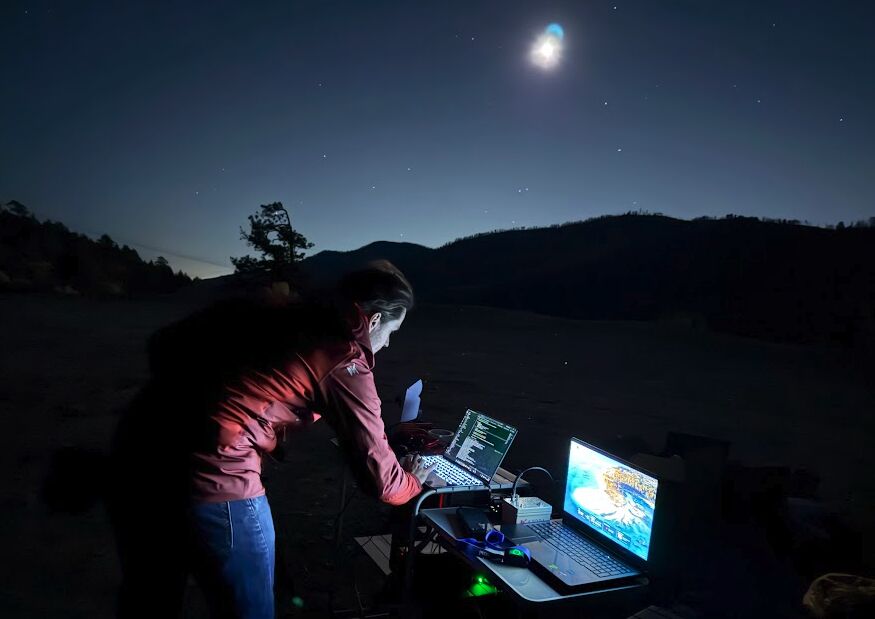
On April 1, 2026 Artemis II launched astronauts back to the moon for the first time since 1972, capturing the imaginations of people around the world; but for James Schalkvyk, CEO of Azora Space, he was interested in capturing something else: lasers. The toilet wasn’t the only interesting new piece of technology onboard the Orion spacecraft that carried the astronauts around the moon, a laser communication system was also being debuted. Orion Artemis II Optical (O2O) was a laser communication system that allowed 4k video to be streamed from over 240,000 miles away with only a second of latency, allowing for all the conversations with media that were had during their 10 day journey. To communicate, the laser beamed data back down to Earth where it bloomed out to a 6km radius area in the California desert. NASA stationed an observatory with a 10m telescope there to capture the signal. James couldn’t pass on such a rare opportunity to see if they could receive the same signal with their much smaller 7cm receivers, so with 3 people, 2 weeks, and 1 optical receiver the size of a shoebox they managed to pick up the signal from Orion, knocking China out of third place for longest laser communication and taking the podium alongside NASA.
There’s a saying that goes something like “If you aim for the stars and you miss, at least you end up at the moon” that captures James’ journey well. Prior to founding Azora he worked on Breakthrough Starshot, the Stephen Hawking project to launch an interstellar probe to another star. As James recounts “the problem was that once you’re at Alpha Centauri, you’re four light years away and it’s very very hard to get any usable signal over that distance when you have so little mass and power budget…the only way that we found that this was going to be possible was if you could completely rethink the way we do ground systems…[to] mass produce glass light buckets with sensitive detectors and distribute those widely to get the kind of kilometer scale collecting area, and if you could do that, we realized you could apply this to these problems that we’re seeing close to home distributing optical terminals around the world to give us this the sort of near real-time connection with space.” Artemis II was a validation of his conclusion, and with further Artemis missions planned to fulfill NASA’s Ignition plan to colonize the moon, Azora is poised to be a critical link in our interplanetary communication chain. The Moon is an ideal target to scale out this technology as it is more cost-sensitive than the Earth to deployment of ground-based communication networks, but without atmosphere and shorter distances from orbit it is ideal for using laser communications to connect bases all over the surface and in orbit. There will still need to be a connection back to Earth, and that’s where Azora can provide their solution at a scale necessary for persistent communication. No matter where the Moon is in its orbit around Earth, there will be an Azora ground station staring up at it to keep humans connected across such a vast distance.
The Moon is not the only satellite that Azora plans to communicate with, amongst Earth orbit, optical communications is proliferating rapidly. The PWSA has been a constellation mandated to use this technology which has accelerated its adoption primarily in space-to-space communications, but eventually that data has to come back to Earth. The Laser Communications Relay Demonstration (LCRD) was a NASA satellite launched to GEO in 2021 in anticipation of broader adoption by defense and commercial operators. Azora has used this satellite to validate their technology, establishing an impressive 20,000 mile link to downlink data 100x faster than traditional RF connections. Their success demonstrating such a distant link has led them to also participate in European efforts through ESA’s ScyLight and HydRON programs to mature laser communication capability. The diversity of these partnerships further demonstrates the flexibility of their solution to be interoperable with any system and optical terminal which has been a key factor in the adoption of this new modality of communication.
Laser communication has enabled new capabilities in space by interconnecting satellites, but the higher data rates flying around in orbit has amplified the bottleneck that is space-to-ground communications. Money is pouring into many RF ground station companies like Northwood to address the issue, but they face physical and regulatory constraints even with limitless financial resources. SpaceX has been filing to increase the power limits on their Starlink terminals, but even at higher levels they can only achieve 200Mbps, 100x slower than optical links. The broader beamwidths are also a detriment on numerous levels, it means the frequencies have to be heavily regulated by agencies like the FCC to avoid interference across operators. The impact is so severe that SpaceX was willing to spend $17B on Echostar’s spectrum licenses last year for a modest increase in bandwidth. Even with broad frequency rights, the nature of RF leaves it easily susceptible to eavesdropping from adversarial entities. Lasers have such tight beamwidths that interference is not as big of an issue, and makes it extremely hard for enemies to get close enough to capture the signal. These factors are a tailwind for Azora to address the ground link bottleneck with a global network of optical terminals because as James claims “once you have 250 stations, your average time between drops to every 8 minutes. which is really more than enough for sort of near constant connectivity.” Global distribution is made feasible by the size of their terminals, since they are so small that they are easily portable and do not require the same infrastructural support that traditional RF ground stations need. This mobility also makes it appealing for flexible applications like the defense demands we’ve seen for mobile ground stations, which Azora has seen as well since James explains “we’ve caught the eye of the defense and intelligence community which is increasingly moving away from sort of exquisite targetable expensive sites for all sorts of equipment right into the idea of proliferated low cost devices that they can use…at the edge in a matter of hours instead of months…That’s where we’re seeing most of the immediate demand.”
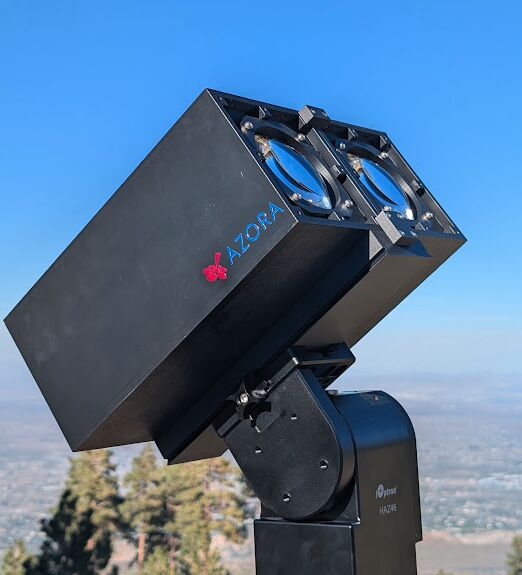
Until Azora’s full global network is deployed, this mobility allows them to address interim demand not just from defense customers, but the increasing number of commercial companies as well. In January Kepler launched their first tranche of laser interconnected satellites enabling realtime payload operations, and in our conversation with Open Cosmos CEO Rafel Jorda Siquier we learned that they’ve experimented with space to ground communications as well to improve the reactivity of their ConnectedCosmos constellation. For both defense and commercial entities, deploying an Azora terminal to an area of interest could enable them to have near real-time communications with their satellites, enabling new capabilities like tip-and-cue tasking of imaging and RF sensing. As laser networks mature this capability will grow easier and more expansive with tools like Aalyria’s Spacetime product that manages networking across nodes that are laser interconnected. This means satellites, ground terminals, and ground networking sites can operate together seamlessly to expand access to sensors and compute capability. Real-time communication with an Azora terminal can mean getting a stream of sensor data from a satellite, routing it to large scale computation hub on Earth or in space, and delivering it to the end user in a matter of seconds, seamlessly augmenting customers with a global, and eventually interplanetary, grid of resources.
By lassoing lasers around the Moon with Orion, Azora has proven the ability of lasers to address the quickly growing volume of data flying around Earth and throughout space. Whether your mission is orbiting our planet or flying to another, integrating with an Azora terminal can unlock orders of magnitude improvements in your capability. If you are interested in what laser communications can do for your satellite, and the possibilities it can unlock, then check out Azora Space.
Watch the full interview on YouTube.




Leave a Reply